
| Welcome | About | Introduction | Chapter One beginning of time – 999 AD |
| Chapter Two 1000 AD – 1399 | Chapter Three 1400 – 1599 | Chapter Four 1600 – 1649 | Chapter Five 1650 – 1699 |
| Chapter Six 1700 – 1749 | Chapter Seven 1750 – 1799 | Chapter Eight 1800 – 1819 | Chapter Nine 1820 – 1829 |
| Chapter Ten 1830 – 1839 | Chapter Eleven 1840 – 1849 | Chapter Twelve 1850 – 1859 | Chapter Thirteen 1860 – 1869 |
| Chapter Fourteen 1870 – 1879 | Chapter Fifteen 1880 – 1884 | Chapter Sixteen 1885 – 1889 | Chapter Seventeen 1890 – 1894 |
| Chapter Eighteen 1895 – 1896 | Chapter Nineteen 1897 – 1899 | Chapter Twenty 1900 + post cinema | Chapter Twenty-One Addendum 1911+ |
| Copyright | HOTDOC Internet Archive Channel | HOTDOC X Channel | HOTDOC You Tube Channel |
Period: 1880 – 1884

Images Cinémathèque française
Animation HOTDOC
1880s
ANIMATED PORTRAITS
JOHN ARTHUR ROEBUCK RUDGE (1837-1903)
WILLIAM EDWARD FRIESE-GREENE (1855-1921)
Driven to produce cinematography, tutor Rudge and student Friese-Greene gave us two seconds of movement on a screen.
Was this boy the subject?


These twelve portrait photographs taken by John Rudge may have been shown on a four-lens instrument and latter shown on a “12-photo double wheel projector.”
On the matter, Stephen Herbert at The Optilogue tells us;
This moment in pre cinema history began with four lenses that Herbert calls a “four-lens optical (or ‘magic’) lantern.” Taken as a negative on glass, they were transposed into positives.
These twelve portrait photos are from Bibliothèque du Film, (Cinémathèque française) via the Optilogue.

Video courtesy The Optilogue
Made into a Flip Book, this animation was made by Stephen Herbert in 2022, showing phases of the boy’s face that J.A.R. Rudge created for one of his multi-image glass slide projection lanterns.


That this sequence of portraits had no plan for smooth motion goes without saying.
The boy is clearly posing. No indication of smooth movement is suggested.
These men provided a glimpse into the future by projecting twelve photographs to a conference room of people in 1890.
By 1889, the four lens lantern was ready for practise, and Friese-Greene utilised it with flexible film at only five frames per second. William himself was the subject of some of these experiments with Rudge, as we’ve seen before in these well-known, silly-face poses of him.

Driven to produce cinematography, tutor Rudge and student Friese-Greene gave us two seconds of movement on a screen


Here, courtesy of The Optilogue, is pre cinema pioneer William Friese-Greene like no one alive today has ever seen him before. Produced with modern AI technology by the online genealogy platform My Heritage, with portrait photos provided by the National Science & Media Museum.
Is this how WFG looked while presenting his animated portraits of Hyde Park in 1890?


Camera Obscura portable tent, from the Catalogue of Queen and Company 1880, taken from p166 of Simon Henry Gage and Henry Phelps Gage, Optic Projection, Comstock Publishing, New York, 1914.
1880 ONWARD
WITHIN ARMS REACH OF MOTION PHOTOGRAPHY
JOHN ATKINSON GRIMSHAW (1836–1893)
Grimshaw was an English painter from Leeds, best known for atmospheric moonlit street and dock scenes—often wet cobblestones reflecting gaslight, foggy harbours, and quiet nighttime city views becoming cinema’s ‘atmospheric perspective.’

So much so that Grimshaw’s work sometimes intersects with the technological side of visual culture within fine art and cinema.
He is believed to have used optical aids such as a Camera Obscura or lenses to project scenes onto canvas in a way similar to Caneletto and Vermeer. That combination of painting, optics, and photography places him within an arms reach of the visual-technical culture that produced early motion photography.
Grimshaw had a connection to both early cinema and Louis Aimé Augustin Le Prince. Both men were active in Leeds in the same late 19th century artistic and photographic milieu. Grimshaw lived and worked in Leeds most of his life. Le Prince moved to Leeds in 1866 and conducted his experiments there.
Paintings by Grimshaw share several compositional traits that later appeared in early cinema
Leeds at the time had a dense network of artists, photographers, and optical experimenters, including societies and art schools connected with photography and applied arts. Le Prince shot his famous 1888 motion sequences such as Roundhay Garden Scene and Leeds Bridge in that same city environment.
And because Grimshaw was a prominent Leeds artist interested in photography and optical projection, documentary films about Le Prince sometimes mention him to illustrate the visual culture of Leeds that preceded cinema. The first film (2015) comes to mind.
A very specific Grimshaw painting that has a slightly similar look to a frame from Le Prince’s Leeds Bridge—the visual resemblance between his nocturnal city scenes and early motion photography─ is surprisingly strong.


This Grimshaw painting in particular lines up uncannily with the world of Louis Aimé Augustin Le Prince. It shows Leeds Bridge around 1880. Grimshaw liked the river. Le Prince liked the street.
The scenes include:
🎨🎥 warehouses along the river
🎨🎥 barges and industrial traffic
🎨🎥 pedestrians watching the river from the bridge
🎨🎥 the dense commercial district around the River Aire
Grimshaw was depicting daily urban movement and traffic in the same place where Le Prince later placed a camera, within feet of the easel.
In 1888, Le Prince filmed Leeds Bridge showing horse-drawn carriages, pedestrians, and carts crossing the bridge—essentially the same subject matter as Grimshaw’s painting.
So, the connection here is visual and geographic. Grimshaw painted the Victorian city that Le Prince would soon photograph in motion.
GRIMSHAW VS. EARLY MOTION-PICTURE FRAMING
There is another very specific visual similarity between Grimshaw’s compositions and the framing used in early motion pictures. It’s almost like a proto cinematic way of seeing the street.

Paintings by John Atkinson Grimshaw often share several compositional traits that later appear in early cinema.
Typical Grimshaw structure:
🎨🎥Fixed viewpoint
🎨🎥The viewer stands at street level or bridge level
🎨🎥The perspective rarely moves—exactly like a stationary camera
🎨🎥Deep perspective corridor
🎨🎥Streets or bridges recede strongly into the distance
This creates a visual path along which movement occurs.
Movement across the frame:
🎨🎥pedestrians
🎨🎥carts
🎨🎥horses
🎨🎥river traffic
Light sources shaping the scene
🎨🎥gas lamps
🎨🎥moonlight
🎨🎥reflections on wet streets
These elements naturally produce layered motion zones—foreground, middle ground, background.
Grimshaw is believed to have used optical aids such as a Camera Obscura or lenses to project scenes onto canvas in a way similar to Caneletto and Vermeer
COMPOSITION AND MOTION RECORDING
Painters like Grimshaw were already organizing urban scenes in ways that:
🎨🎥 emphasize time passing
🎨🎥 show multiple simultaneous movements
🎨🎥 create visual pathways for motion

Early filmmakers naturally pointed cameras at exactly these types of scenes, because the compositions were already ideal for recording movement. This is why many of the very first motion pictures focus on:
🎨🎥 streets
🎨🎥 bridges
🎨🎥 factory gates
🎨🎥 railway platforms
The scene already contained continuous motion. Grimshaw wasn’t inventing cinema, but he was working within the same visual problem: how to represent modern urban life—crowds, vehicles, light, and atmosphere.
Painters solved it with composition. Filmmakers solved it with motion recording.
Both come out of the same late 19th century visual culture.
MUYBRIDGE’S OTHER DISK ARTIST
ERNST F. FABER
Ruth the mule was first photographed by Eadweard Muybridge and then, traced and filled in with 13 images of her kicking, by Erwin F. Faber onto a 12-inch disk for the Zoopraxiscope. Faber was the lesser-known artist and technician of two, the other being Thomas Eakins, who worked on hand-painted images for Muybridge’s projector in the 1880s and 1890s.
Animation Kingston-on-Thames Public Library


Faber worked during the 1880s on the original 16‑inch glass projection discs for the Zoopraxiscope, helping Muybridge hand-paint the sequences directly from his photographs. These disks were part of Muybridge’s lecture performances between 1880 and 1895.
These were photographically printed from outlines drawn by Faber and then filled in. They were intended for sale at the 1893 Chicago fair but sold poorly and are extremely rare today. Only about 4 or 5 of the coloured paper discs are known to still exist.
Muybridge’s Zoopraxiscope developed in 1879, and publicly used during the 1880s–1890s, projected painted sequences on glass disks, often based on his photographic motion studies.
The painted figures on these glass disks weren’t always direct photographic tracings: some were stylized or idealized versions of movement. Erwin F. Faber was one of the painters commissioned by Muybridge to help translate motion images into circular painted frames on the glass plates used in the Zoopraxiscope.
This is similar to Thomas Eakins, who also worked at Penn U, and was a visual interpreter of Muybridge’s sequences, blending science and art.
Called the Heidi Wastweet ‘Muybridge Spinning Bronze Tribute Medallion’ based on Muybridge’s ‘The Horse in Motion’ 1878, animation by Sharon Niemczyk.


Faber wasn’t just a technician—he added artistic interpretation to the imagery, helping blur the line between scientific study and aesthetic presentation. This may be why some Zoopraxiscope disks show movement that doesn’t exactly match Muybridge’s sequential photographs. Faber may have taken liberties in continuity or Silhouette to make the motion more fluid or stylized.
Faber isn’t well-documented in most of my primary sources. His name is buried in specialist literature like technical appendices or museum catalogues. Most recognition for the Zoopraxiscope went to Muybridge alone, even though painters like Faber were essential to the final product.
Eakins collaborated with Muybridge on some of the earliest 16‑inch glass projection disks with Faber, used in the US and European lectures from the 1880s to mid‑1890s. Faber worked later from 1892–1894 on the 12‑inch printed glass disks and the paper Phenakistoscope disks produced for sale at the 1893 Chicago World’s Fair.
A rule-of-thumb I have found is that if it’s a 16-inch disk it’s probably an Eakins disk, and if 12-inches, likely Faber’s.


Left
Twelve phases of Studies in Zoopraxography EM, copyright 1893, arranges for the Zoopraxiscope #33 Parrot Flying.
Right
Thirteen phases of Studies in Zoopraxography EM, copyright 1893, arranges for the Zoopraxiscope #34 Grecian Dancing Girls. Both believed to be Faber disks but cannot be verified.


‘Athletes Running,’ a rare painted Phenakistoscope disk featuring track athletes and an imaginary crowd, is attributed to Faber.
In general, Faber’s disks include scenes drawn from Muybridge’s motion studies; athletics, human locomotion, birds in flight, horses galloping, rendered by outline, printed photo‑reproduction, then hand‑coloured.
In total, about 71 known 12-inch glass disks and approximately 50 paper disks, some which are pictured here, were created in this later phase. Thomas Eakins ‘Waltzing Couple’ and ‘Athletes Boxing’ are both 16‑inch glass lecture disks.
Erwin F. Faber ‘Athletes Running’ and other athletic/human sequenced12‑inch coloured glass disks and rare paper Phenakistoscope disks.
WHO’S DISK IS WHO’S
If the disk is a large, Silhouette‑style projection disk used during Muybridge’s lectures (1880s–mid‑1890s), it’s almost certainly associated with Thomas Eakins. If instead it’s one of the slightly smaller 12‑inch printed‑then‑hand‑coloured glass disks, or one of the World’s Fair paper disks (c. 1893), then you’re looking at work designed and drawn by Erwin F. Faber.
Finding images where attribution to Erwin F. Faber or Thomas Eakins is explicitly confirmed, can be tricky I have found, because many archival photos and museum scans lack clear labelling. I can safely say that:
🎨 The Waltzing Couple (image in Marta Braun’s Picturing Time [2000], Figure 8.2 [p142], showing the couple dancing)


🎨 Athletes Boxing (confirmed through the University of Pennsylvania archives [Muybridge’s home institution, where Eakins also worked] Are both confirmed Eakins disks.


The only disk that my research can absolutely identify as having been painted by Faber is:
🎨 Athletes Running (Hand-drawn and chromolithographed 12-inch paper Phenakistoscope disk from the Chicago World’s Fair in 1893) And I’ll stop there for fear of pretending to know more than I do.


1880
HONOURABLE MENTION
THE PANORAMIC ROTATIVE CAMERA
ALBERT EUGÈNE FERNIQUE (1841–1898)
Albert Fernique is a fairly obscure but legitimate figure on the edge of pre cinema—more technical than theatrical.
Fernique was a French photographer, engineer, and instrument maker active in the late 19th century. He is best known for designing precision photographic equipment, working on Panoramic photography systems and contributing to scientific and military imaging techniques.
He was not a showman like lanternists, nor a theorist like Plateau. Fernique developed a mechanized panoramic camera system, sometimes referred to as a Panoramic Rotative Camera.
This camera of which no image seems to exist, rotated during exposure, capturing continuous wide-angle views, and required careful synchronization of motion while exposing.
Fernique is not part of pre cinema in the entertainment sense (no Magic Lantern shows, no projection systems, no animation devices). But he does intersect with pre cinema at a deeper structural level.
EXACT SAME ENGINEERING INFRASTRUCTURE

1. MECHANIZED IMAGE CAPTURE
His cameras introduce controlled mechanical movement during exposure and treated image-making as a time-based process, not a static one. That’s a key conceptual step toward motion pictures.
2. PROTO CONTINUITY ACROSS SPACE AND TIME
Panoramic photography unfolds space progressively and requires the viewer to mentally reconstruct a continuous scene. This is not motion, but it trains the same perceptual habit cinema later exploits, by assembling fragments into continuity.
3. OVERLAP WITH CHRONOPHOTOGRAPHY CULTURE
Fernique’s work exists alongside figures like Étienne-Jules Marey, Eadweard Muybridge and all the other Chronophotographers. While there is no strong evidence of direct collaboration, they share interest in mechanizing vision and the use of their apparatuses to analyze or extend perception. Fernique leans toward spatial sweep, Marey toward temporal segmentation—but both move away from single, fixed images.
4. MILITARY AND TOPOGRAPHICAL IMAGING
Fernique also worked in survey photography and military documentation. This is important because these fields demanded accuracy, repeatability, and systemization, the exact same demands that later shaped early motion picture cameras and their operators, the cinematographers.
There is no well-documented, widely cited surviving Fernique camera in the way we have for Marey or the earliest of cinematographers. Fernique’s apparatus belongs to the family of rotating Panoramic cameras, but with a precision-engineering emphasis.

Unlike Marey or Reynaud, Fernique’s legacy is documentary and technical, not object-centred. So the trail is papers, diagrams and references in proceedings —not the iconic surviving devices themselves.
From what I can gather from the documentation I have seen without any images, the configuration appears to have been a rotating body which probably sat on a pivoting axis like a camera mounted on a tripod.
It was either hand-cranked or clockwork regulated. The film or plate was exposed through a narrow vertical slit as the camera rotated and the image was scanned across the surface.
IMPORTANT
This is central to his Panoramic Rotative Camera because the image is built over time during the pan, not captured in a single instant.

In 1870 he worked with René Prudent Patrice Dagron (1819-1900) to establish a microphotography carrier pigeon service in the French provinces.
Fernique also worked with Joseph-Charles d’Almeida of whom I have spoken on.
Unfortunately, there are no known patents directly tied to Panoramic photo-motion systems under Fernique’s name that I could find. However, Fernique does belong to the exact same engineering infrastructure that made cinema possible.
1880
PROMOTING THE MOVING PICTURE
CHARLES-THÉOPHILE ARAMBOUROU (1858-1919)
Arambourou was a pioneer of early post cinema in provincial France. He was the son of Antoine Arambourou, a Spanish Basque refugee who had taken up photography, and of Laurence Mazaury. Charles spent his childhood in Touraine before settling in Châtellerault around 1880, where he opened a photography studio on the Boulevard Blossac.


He witnessed the very beginnings of commercial cinema in France at the end of December 1895 in Paris, and could not remain merely a spectator. He acquired an Héliocinégraphe of Perret and Lacroix, and converted a space he had acquired into a dedicated screening room he called the Théâtre des Attractions.
On 20 September 1896, his first screening took place, making Arambourou the first person to offer cinematograph sessions in Châtellerault. He showed both imported films and films he shot himself locally.
Among the most popular was a film of a train’s arrival at Châtellerault from Senillé, accompanied by sounds recorded on site and played back via a Phonograph, which reportedly made audiences squirm in their seats, just like other train-coming-into-the-station films had done.

RESTORATION IN 2024
Arambourou filmed a major flood of the Vienne River in October 1896, capturing a rare historical slice of local life.
From November 1896 to April 1897, he took his Héliocinégraphe on the road, organizing screenings across the Vienne (Poitiers, Civray), the Charente (Ruffec), and the Deux-Sèvres (Thouars, Niort).
Pictured are two shots of Arambourou with the Héliocinégraphe camera, and the patent.
He is recognized as the first cinematographic operator in Poitou and an essential promoter of early cinema in the French provinces.


He worked from his Châtellerault studio until his death in 1919, and his son Eugène continued the photographic tradition after him.
In short, he was a local photographer-turned-cinema pioneer who brought moving pictures to a corner of France that had never seen them before, and even invented his own films along the way.
His films, only recently rediscovered, were restored in 2024 by the Cinémathèque de Nouvelle-Aquitaine.
UNE HISTOIRE DE CHARRETTE 1896
Patrick Malefond, director of the Cinémathèque de Nouvelle-Aquitaine, described the find with wonder: “These are the first films ever shot in the Vienne. The oldest known images of Limoges date from 1913 — images from the 19th century are extremely rare!”
It was André Chêne, the last photographer to run the Studio Arambourou, who had the foresight to preserve the films and photographs by entrusting them to the Archives municipales of Châtellerault.
They were then digitised and restored by the Cinémathèque in 2024 using professional scanning and digital restoration tools to remove scratches, dust, and instability — while being careful, as the restorer put it, “not to go too far and strip away the authentic grain of the original.”
I must say, the Perret and Lacroix Héliocinégraphe was a remarkable camera, having such clarity and smoothness.
From historical press records and the restored collection, the known titles are:
📽️ La Crue de la Vienne (The Flooding of the Vienne) — filmed at the peak of the flood on October 30, 1896
📽️ Le Bateau de sauvetage (The Rescue Boat) — shot at the same time during the flood
📽️ Le Rouleau à vapeur (The Steam Roller) — presented in February 1897
📽️ Une histoire de charrette (A Cart Story) — a donkey-drawn cart and a lady offered flowers, seen above.
Earlier screenings also included films he may not have shot himself, such as Les Brûleurs d’herbes, Les Bateaux de Dieppe, Le Train, Une scène de famille, and Une partie de campagne, listed in a review from Le Mémorial du Poitou of 23 September 1896.

In total, ten films were restored, nine of which were presented at the public premiere screening on 10 July 2024 at the Ciné-Bourse in Saint-Junien, and a second public screening followed on 29 November 2024 at the Cinéma Les 400 Coups in Châtellerault, presented as a ciné-concert with live music accompaniment. Three of his nine films can be seen here.
1880s
ARTHUR ALBERT (ESMÉ) COLLINGS (1859–1936)
Collings was born in Weston-super-Mare, Somerset, England and began on his road to cinematography working at his father’s boot-making company until his passion for photography took over. He made no true contribution to pre cinema except by advancing the new medium alongside several pioneers.

One such pioneer was the already-established William Friese-Greene, who helped Collings establish a very prosperous company in Brighton, Liverpool and London (Piccadilly) beginning in the late 1880s.
Besides also being an illustrator and painter, Collings is one of the lesser-known but genuinely pioneering figures who did his part in bridging late Victorian photography with Edwardian moving pictures.
His early career focused on portrait miniatures and pictorial photography, often with strong painterly qualities.
HIS MOVE TOWARD MOTION PHOTOGRAPHY
By the mid-1890s, Collings was experimenting with Chronophotographic and cinematographic techniques, very shortly after the first public demonstrations.
Collings’s early films are among the earliest narrative and what became known as erotic subjects known in British cinema. While many are lost, several short pieces survive such as this one called A Victorian Lady in Her Boudoir or Woman Undressing (1896) pushing the boundaries of what could be shown.
Around 1896, he began producing some of the earliest British motion pictures, both independently and in association with George Albert Smith and James Williamson, who together formed the so-called Brighton School — a cluster of experimental filmmakers active around Brighton and Hove (UK).
On the left was is referred to as a Trade Plate (business card), image Sussex Photo History. On the right is a mother and her daughters posing in one of the Friese Greene and Collings studios, image Royal Pavilion & Museums, Brighton and Hove.


Stylistically, his work shows strong links to the photographic studio tradition — static camera, theatrical composition, and emphasis on lighting and gesture rather than editing or motion continuity.
Pictured: The photographic studios run by the firm of Friese Greene and Collings as detailed on the reverse of a cabinet portrait c. 887. This young girl is unknown to time. Images Sussex Photo History.


Collings’s contribution sits at a critical junction between pre cinema and early cinema. His work translates the pictorialism of Victorian photographic tableaux into the new temporal medium — a direct descendant of Magic Lantern slide poses and “living photographs.”
The Brighton School milieu itself emerged from lantern exhibition culture; many of its members (including Collings) were already using projection techniques for commercial portraiture or optical entertainments before adopting film.
His films labelled erotic, echoed earlier poses plastiques / tableau vivant and lantern Dissolving Views that combined still images, coloured light, and implied motion.
Here is an illustration of a photographic studio employing electric light in the 1880s. Esmé Collings fell out with his business partner William Friese-Greene over the cost of supplying electricity to their Piccadilly studio.
Image Sussex Photo History

Collings is one of the lesser-known but genuinely pioneering figures who did his part in bridging late Victorian photography with Edwardian moving pictures
Esmé Collings withdrew from filmmaking almost as quickly as he entered it. By the early 1900s he returned to still photography and painting, operating studios in Liverpool and London into the 1910s.
His cinematographic work, though brief, was rediscovered and reassessed in the 1970s and 1980s as scholars mapped the Brighton pioneers’ role in the birth of narrative film.
Commonly called Children Paddling, this short 48 second film of Esmé Collings shows children being supervised at the sea shore in 1896. The boy is far more interested in the camera than he is with the sea or the girls.
Collings was one of the earliest British filmmakers, emerging directly from the photographic and lantern world. His 1896 films, studio-based, erotic, and tableau-like embody the transition from static pictorial illusion to projected moving image.
Though overshadowed by contemporaries like Friese-Greene, Smith and Williamson, Collings’s work stands as a vital pre cinema bridge, a photographer translating Victorian visual conventions into motion for the first time.
FIBRE OPTICS IN 1880
TRANSMITTING SOUND THROUGH LIGHT
THE PHOTOPHONE OF BELL AND TAINTER
Scottish-born scientist and inventor, Alexander Graham Bell regarded the Photophone as his most significant creation, even though he is most recognized for creating the telephone. On 3 June 1880, Bell sent the first wireless telephone message using his newly created Photophone, an appliance that could send sound through a beam of light.

Bell owned four patents for the Photophone and manufactured it with the help of an assistant, Charles Sumner Tainter (1854-1940). The first wireless voice transmission spanned 700 feet.
Bell’s Photophone worked by projecting his voice toward a sending mirror. Vibrations in the voice caused oscillations in the mirror. Take a look at the side-view mirror of your car next time you have the volume cranked up.
Bell then directed sunlight into the sending mirror, capturing and projecting the mirror’s oscillations toward a receiving mirror, where the signals were converted back into sound at the projection’s end.
The Photophone and the Telephone were similar devices, but the Photophone projected information using light, whilst the Telephone used electricity through a wire.


The Photophone was the first wireless communication device, about 20 years before the development of the radio.
Bell’s effort was not entirely appreciated in 1880, despite the fact that the Photophone was a very significant invention. This was mostly because of technological constraints: the Photophone was unable to shield transmissions from external interference’s like clouds.
The Photophone was highlighted in an article in Nature 4 November 1880.
Image Apic / Hulton Archive / Getty

Things changed over a century later, when fibre optics were invented in the 1970s, allowing light to be sent securely. Indeed, Bell’s Photophone is regarded as the forerunner of the present fibre optic telecommunications technology, which is commonly utilized to send telephone, cable, and internet signals across long distances.
In an interview later in life, Bell proclaimed, “In the importance of the principles involved, I regard the photophone as the greatest invention I have ever made; greater than the telephone.” Little did we know at the time, that light will also transmit pictures.
WATCH this video that puts the Photophone into perspective. It runs three minutes, twelve seconds.

Images and animations de Luikerwaal, Daan Buddingh
1880
MECHANICAL SLIDES FOR THE MAGIC LANTERN
Mechanical Magic Lantern slides were a simple motion entertainment toy enjoyed by adults and children.
They could be operated in-hand or placed in a Magic Lantern and broadcast to a gallery of people. Unlike standard slides that show a single static image, mechanical slides incorporate moving parts—typically operated by levers, pulleys, or rotating disks—to create simple animations or transitions.
Sometimes all that was needed to create the animation, was the tip of a finger. These slides were often hand-painted on glass and used for entertainment, education, or storytelling. All slides shown are from the Virtueel toverlantaarnmuseun de Luikerwaal and my friend Henc de Roo.

These 19th century optical devices were so simple to operate – by just moving the handle up or down, or cranking it – or moving a lever in or out, brings the image to life.
They were popular in Victorian-era Magic Lantern shows, often used to amaze audiences with their “moving pictures” before the invention of cinema.
The most Common Types of Mechanical Slides were:
🎞️Rackwork or Lever-action slides – Use sliding glass panels or levers to animate part of the image (e.g., a person waving, eyes moving, a wheel turning).
🎞️ Chromatrope slides – Use rotating coloured disks to create kaleidoscopic effects.
🎞️Dissolving views – Use two overlapping slides and a mechanical dimmer to transition between scenes, like day turning to night.
🎞️Slipping slides – Have images that slide across to change the scene or motion.
The urge to animate projected pictures led to the development of several inventive mechanical slides.
These kinds of slides employed sliding plates, pulleys, levers, and rackwork to give the items on display life and motion.


Here’s two Magic Lantern slides called Girl Skipping and Dog Skipping. The speed at which the lass skips can be varied according to the enthusiasm of the user. Same for the dog. These hand-painted slides were common in Victorian Magic Lantern shows, a form of pre cinema projection entertainment.
The frame in your image (wood and metal mount) is a giveaway — it’s consistent with British or German-made mechanical lantern slides, especially those manufactured by Ernemann in Germany, or Carpenter and Westley, or Newton and Company in the UK.
They may have also been manufactured by anonymous cottage-industry producers in England, France, and Germany. The skipping motion is achieved via internal mechanical gears or a sliding lever that animates the limbs or rope in a loop.
These were used both for education and entertainment, and animations like skipping, walking, or dancing were very common.
Animation de Luikerwaal


Animation de Luikerwaal
MAGIC LANTERN SLIPPING SLIDE
The simplest way to convey pre cinema movement to the viewer is the use of two slides, painted on the same glass. This shows two phases of the story you are telling.


Animation de Luikerwaal
During the projection, the painted slides had to be changed quickly by pushing or pulling the glass in a lateral direction back and then forth.
This de Luikerwaal simple slipping slide shows these two boys fighting, is fitted in a tin frame that measures about 7 1/4″ x 2 5/8.
Animation de Luikerwaal
Windmills are a favourite subject for what is known as rackwork slides. Turning the handle makes the sails go round. Many Mechanical Magic Lantern Slides measured 7″ x 4.”
Some measured as small as 5.5″ x 3″.

The round glass slide mounted in wood and brass hardware, with a hand crank mechanism, is characteristic of rack-and-pinion slides used in higher-end lanterns. The circular movement of the windmill sails is driven by internal gears powered by the crank on the side — an early mechanical animation technique.
The painted scene (with fine pastoral detail) suggests either German or British manufacture, possibly, Ernst Plank (Germany), Gebrüder Bing (Germany), or Newton & Company, W. C. Hughes, or Carpenter and Westley (UK). They were a hit in Victorian parlour shows and educational lectures, offering both novelty and charm.

Animation de Luikerwaal
SINGLE LEVER SLIDE
These slides give movement to the subject by the use of two glasses, one of which is a fixture in the frame and the other is free to turn in a circular direction by means of a lever.
A lever-type slide showing two women in front of a bath carriage that brought them to the edge of the sea. The women are fully dressed in vintage bath suits. When the lever is moved up and down the younger girl jumps in the water while the elder one holds her hands.
Animation de Luikerwaal
Here is an animated Mechanical Magic Lantern Slide called Sergeant Before the New Recruits.
It’s a Single Lever Slide.

The urge to animate projected pictures led to the development of several inventive mechanical slides

Image de Luikerwaal
Sergeant Before the New Recruits, a single lever slide.
When the lever is moved, the sergeant swings his stick.
The slide measures 7 “x 4.5” (18 x 11.4 cm).
Animation de Luikerwaal
1890
PIVOTED-LEVER SLIDE
This Pivoted-Lever Slide’s mechanism is a system of four synchronously turning painted glass pieces to create the appearance of a Chinese man dancing.
There is a fifth piece that remains stationary (torso).


Animation de Luikerwaal
1880, Les Danseurs de Corde (The Cord Dancers). Hand painted, two dancers on a cord. Their concentration is lost and both fall. The frame measures 11.4 by 4.3 inches and has six movements, or pre cinema ‘frames’.
I can just see the little children howling in laughter. French made.
A double-slipping slide showing three performing acrobats in the top left, and three other hilarious Mechanical Magic Lantern Slides. Wonderful family motion entertainment taking place in the parlours and living rooms of the world, with fluid motion just around the corner in the form of Cinematography.
Animations de Luikerwaal


PHOTOGRAPHIC FIRSTS
BETWEEN 1832 & 1889
Of the known 130 photographs of Abraham Lincoln, this is the first authenticated one of him.
At the time he was US Congressman-elect in 1846. Photography attributed to Nicholas H. Shepard.
It has been referred to as both a quarter-plate and a sixth-plate Daguerreotype.
It has a history, having descended from the family of the sixteenth President’s personal secretary.
A Daguerreotype Camera Obscura built by La Maison Susse Frères, Paris in 1839, with a lens by Charles Chevalier.
This authenticated camera was one of the first two photographic cameras ever sold to the public.

Below is a section of La Daguerréotypomanie, which was a lithograph produced by Theodore Maurisset for the inauguration of the Daguerreotype invention’s commercial introduction to the public following Arago’s announcement in 1839. Cameras everywhere.


Below is a reliably dated Daguerreotype taken by Daguerre.
It was taken in 1837 and is considered a simple still life picture with plaster cast décor of cherubs and a ram, a framed picture, curtains, embossed nude and a possible wine or water jug.
Here is the title page of Daguerre’s 1839 manual written for instruction on the new process of sun drawings.
It was published soon after Arago’s lecture, to meet the intense public demand for more information about the process.
Read it here at Google Books.


This image has never been disproven as far as I know, as the earliest known photograph of a living animal.
This Daguerreotype is from French photographer Joseph-Philibert Girault de Prangey in Rome, sometime in the spring or summer of 1842.
A Daguerreotype of Andrew Jackson, seventh president of the United States taken in 1845 by an unknown photographer.
Jackson was 78.
He gained fame as a general in the United States Army and served in both houses of the US Congress.


In 1857 pioneering Japanese photographer Ichiki Shirō ( 市来 四郎 ) took the earliest surviving Japanese photograph.
The photograph was of feudal lord Shimazu Nariakira ( 島津ナリアキラ ).
Using the Daguerreotype process, the first correctly exposed photograph of a solar eclipse is taken by Prussian photographer Johann Julius Friedrich Berkowski 28 July, 1851.
He used a small refracting telescope and began exposing at totality, taking an 84-second exposure.
This image has been enhanced.

Image the Friedrich Schiller University Jena Museum via the Linda Hall Library

These are six tourism and marketing Daguerreotypes, showing views of San Francisco from 1853. Photography has now been incorporated into the tourism and marketing industry.


Here is a printed reproduction of a still life.
The original was believed to be circa 1832, and was taken by Joseph Nicéphore Niépce.
The original glass plate was accidentally destroyed c. 1900 when being cleaned and restored.
Immediately below is Lewis Carroll’s original sepia ink illustration for how he wanted Alice of Alice’s Adventures in Wonderland fame, to look like.
Image Public Domain Review

“What is the use of a book,” asked the character of Alice in the beginning of Lewis Carroll’s Alice’s Adventures in Wonderland, “without pictures or conversations?” This, being in reference to her sister’s house with no pictures.


Seen here is the wee lass herself, eight year old Alice Pleasance Hargreaves (née Liddell) who the Carroll character Alice was based on.
This was just one of many photographs of Alice Liddell taken by Carroll who’s real name was Reverend Charles Lutwidge Dodgson.
It was taken in July 1860.
WORLD’S OLDEST OPERATING CINEMA
Built in 1889, it’s 133 years young in 2023, and the world’s oldest surviving Cinema. It’s still in operation and is called Cinéma Eden Théâtre at La Ciotat on the Côte d’Azur near Marseilles.
Left is the original exterior. Right is the modern interior.


1880
SEEING BY ELECTRICITY
WILLIAM EDWARD AYRTON (1847-1908)
JOHN PERRY (1850-1920)
Ayrton and Perry’s 1880 proposal is one of the earliest serious scientific descriptions of what we would now call electrical television. Although they never built a working system, their paper demonstrated that respected electrical engineers were already thinking about transmitting images electrically nearly half a century before practical television emerged.
Their idea was for transmitting / receiving images electrically, something they called “seeing by electricity.”


William Edward Ayrton was a pioneering British electrical engineer, and professor at the Imperial College of Engineering in Tokyo between 1873 and 1879, and later Professor of Applied Physics at the City and Guilds Technical College in London. John Perry was Ayrton’s close collaborator.
They published numerous papers together on electricity, telegraphy, and electrical measurement. Their work came at a time when the telephone was only a few years old and scientists were beginning to wonder whether vision, as well as sound, might someday be transmitted electrically.
Ayrton and Perry co-authored a letter titled “Seeing by Electricity,” published in Nature, vol. 21, p589 22 April 1880 saying that their receiver design used magnetic needles controlling apertures that illuminated small squares of frosted glass, matched to the selenium squares on the transmitting end, such that “the image of a distant object would in this way be transmitted as a mosaic by electricity.”

Key Details from Their 1880 Nature Letter
Transmitter: A surface of many small separate selenium squares. A strong light / image was focused onto it; each square’s illumination modulated the current in its connected wire.
Receiver: Initially described with magnetic needles or shutters controlling light apertures onto frosted glass squares, creating a mosaic reproduction. Later refinements (around 1881) involved better demonstrations with solenoids and light valves.
They presented it in response to rumours about Graham Bell’s sealed invention and built on Willoughby Smith’s selenium photo-resistance discovery (1873). This was a theoretical / practical proposal (they did some small-scale demos, e.g., single-element tests), not a fully working multi-element TV system—practical issues like needing thousands of wires and selenium’s slow response limited it.
It was part of the broader “selenium era” of early TV ideas alongside others like Carey, Senlecq, and others. READ the Ayrton and Perry letter they wrote to Nature in 1880 here.
Their work came at a time when the telephone was only a few years old and scientists were beginning to wonder whether vision, as well as sound, might someday be transmitted electrically
So popular was the concept of seeing through electricity during the broad “selenium era” of early TV ideas in the last half of the 19th century, that the entire nation, and world, was talking about Ayrton and Perry’s proposal, and writing about it. Besides TV, this concept was a precursor to Faxing.
Amongst all the clippings from newspapers I found, here are four:
■ LEFT ‘Seeing by Telegraphy,’ Nature, 13 May, 1880, unsigned
■ RIGHT ‘Seeing by Electricity’ English Mechanic and World of Science, No. 790, 14 May 1880, signed H. E. Bolton
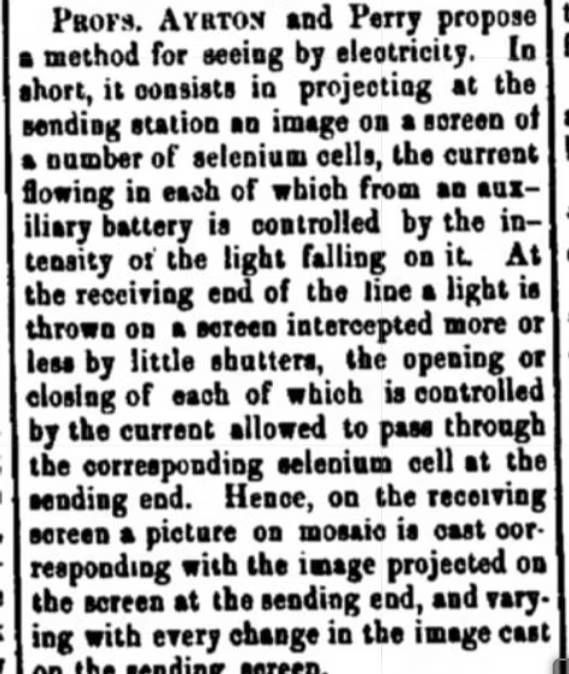

■ LEFT ‘Seeing by Electricity,’ Nature, 29 April 1880, signed J. E. H. Gordon
■ RIGHT ‘Seeing by Telegraph,’ English Mechanic and World of Science, No. 788, 30 April 1880, unsigned


A MAJOR PROBLEM
The proposal required one wire for every picture element (small squares of frosted glass). For example: 100 × 100 picture = 10,000 separate wires. A realistic image might require 250,000 wires or more. Even in 1880 they admitted this was impractical.

Ayrton and Perry explicitly stated that the system was too complex and too expensive to construct with the technology of 1880. It remained a theoretical design only and never saw the light of day.
1880
MASTER OF SHAPING PRE CINEMA VISUAL CULTURE
JOSEPH BOGGS BEALE (1841-1926)
The most famous of American Lanternists, Beale saw his first lantern show as a child. In his professional career he delivered a complete repertoire of shows including themes on Christmas, history, politics, great literature and religion.
Beale is one of those figures who quietly shaped visual culture on a massive scale, even if his name isn’t widely recognized today.

He’s the father of the systematization of visual storytelling. Beale wasn’t just a lanternist—he was primarily an industrial-scale designer of lantern slide narratives. Working out of New York in the late 19th century, he created thousands of illustrated glass slides that were sold worldwide.

THE FRANCHISE KIT
What separates Beale from earlier Magic Lantern artists is that he standardized narrative projection:
🎨🖼️ He produced complete slide sets, not isolated images
🎨🖼️ Each set came with printed lecture scripts
🎨🖼️ Slides were numbered and sequenced for storytelling
🎨🖼️ Shows could be performed by non-experts using his materials
In other words, he turned the Magic Lantern into a mass-distributed narrative medium—almost like a pre cinema “franchise kit.”
Beale did the artwork for his slides himself, like this one below. His designs were hand-coloured after being transferred onto glass, most likely using the Langenheim brothers Hyalotype process of the transfer of photographs onto glass, first seen in 1850. This is the closest thing before film to:
🎞️ a storyboard
🎞️ a shooting script
🎞️ and a distribution package
All rolled into one.
SEQUENTIAL CONTINUITY
Joseph Boggs Beale was a natural and accomplished artist. During his lifetime he created more than 2,000 paintings, sketches and drawings mostly all related to his work as a Magic Lantern projectionist. Over 250 lantern slide ‘sets’ to be precise.


Beale’s output is enormous, but it clusters into a few categories such as historical and quasi-cinematic scenes like American history episodes, dramatic recreations of famous events which were often staged like theatre tableaux.
His visual style is very telling for pre cinema. Beale’s slides are not neutral illustrations—they are staged images designed for projection impact having:
🎬 Strong spotlit figures against dark backgrounds
🎬 Exaggerated gestures (readable from a distance)
🎬 Carefully controlled depth and layering
🎬 Use of sequential continuity between slides
They often look like theatre + painting + early cinematic blocking. There’s a direct line from this to later film staging.
As Andy Stupperich, the Associate Curator for Digital Content at The Henry Ford states, cinematography definitely makes its way into this Boggs Beale conversation, as well as ending it.
Having a life surrounded by Magic Lanterns from his youth and his ability to draw, illustrate and paint, placed him in the very centre of the push towards animated pictures.

Beale’s slides were typically used with:
🎥 Biunial or dissolving view lanterns
🎥 Effects like fades, transitions, and superimpositions
So while the images themselves were static, the performance was dynamic:
🎥 dissolves = proto cross fades
🎥 slide changes = cuts
🎥 narration = soundtrack
This is very close to what later becomes film language. He effectively helped define what mass audiences expected from projected storytelling before cinema existed.
one of the first great screen artistes, being highly skilled at manipulating projected pictures and creating a cinematic tale for his audiences
IT RAN IN THE FAMILY
Beale was born in 1841 into a well-connected Philadelphia family. The Beale family came from the theatrical world with a background in stage productions, various types of concerts, minstrel shows, Panoramas and Magic Lantern shows.
Joseph’s uncle Edmund Beale was in fact a professional Panorama showman himself.


J. B. Beale studied writing and drawing, and in 1862 earned the position of Professor of Drawing and Writing at Central High School — his own alma mater — beating out Thomas Eakins of Eadweard Muybridge fame, for the post.
Beale was first published in November 1865 when he drew this Panoramic Base-Ball Match illustration for Harper’s Weekly.
This began his career. He was soon seen in other major national periodicals like Daily Graphic and Frank Leslie’s Weekly.
Image The Henry Ford


Image The Henry Ford
After his wife died, Beale returned to Philadelphia, where he met Caspar Briggs, owner of C. W. Briggs & Company, one of the country’s premier lantern slide firms.
Briggs originally hired Beale on a freelance basis. A 39-year career illustrating lantern slides then began.
Pictured here is a Beale slide on the hymn “Tell Me the Old, Old Story.”
Briggs later bought the Langenheim Brothers operation. He himself was later absorbed into McAllister & Company. Through these channels, Beale’s images circulated across the US, Britain, and beyond.
Beale’s master drawings were photographed at the Briggs factory, photographically reduced to slide size, and then printed onto the emulsified glass, then produced as either black-and-white or colour slides.
Briggs might make a hundred copies from one of Beale’s drawings — or a thousand, or ten thousand. These slides were sold by over a hundred different companies for use in homes, schools, theatres, fraternal societies, and nearly every Protestant church in the country.
Beale saw the narrative potential of his images when they were projected onto a screen in a theatre. The concept of pictures that move, was being visualised at this moment.
From one of his pictures for the Life of Benjamin Franklin series, Beale depicts a crucial moment in his nation’s founding.

ARTISTIC METHOD AND CINEMATIC QUALITY
Beale developed a special style for screen projection combining three elements:
🎞️ a dramatic story-telling image that drove the action forward
🎞️ meticulous detail that sustained attention while slides were on screen
🎞️ and strong designs that led the eye to the main subject even amid the surrounding detail
He employed roughly 75% of what we now recognize as the techniques of cinematic art:
🎞️ storyboarding
🎞️ continuity editing
🎞️ key lighting
🎞️ varied points of perspective, and more
Beale produced lantern slides that have been dubbed as “cinematic.”
He is regarded as one of the first great screen artistes, being highly skilled at manipulating projected pictures and creating a cinematic tale for his audiences.


Beale didn’t invent new optics. He didn’t invent motion. But he did something arguably just as important:
👁️ He industrialized narrative projection
👁️ He standardized visual sequencing
👁️ He trained audiences to read projected stories
THE OVERTAKING OF MOTION PICTURES
Over the course of his career, from 1881 until about 1920, Beale produced some 2,073 images in 258 sets. This was the screen-time equivalent of 17 full-length movies.
Though they did not know Beale’s name, millions of people a year enjoyed his Magic Lantern screen entertainment.

By 1900, Magic Lantern slide performances were in decline both in homes and in public venues. The progress of Motion Pictures, gaining speed by the late 1890s, gradually overtook lantern slide entertainment. Motion Pictures was now dominating the screen entertainment business.
Beale witnessed the decline of the Magic Lantern as a premiere entertainment spectacle as the Cinema grew.
Today however there are select lantern enthusiasts and professionals around the world performing and keeping the art alive.
The main scholarly resource in my opinion is the work of Terry and Deborah Borton.

Their book Before the Movies (2014) is described as “the first balanced history of early Magic Lantern entertainment in the United States,” with a comprehensive catalogue of Beale’s lantern images.


The Borton’s followed it with Magic Lantern Art, based on his extensive Beale archive, now held by the Lucas Museum of Narrative Art in Los Angeles. Additional Beale materials like his drawings, slides, stamps, and ephemera are held by the Philadelphia Museum of Art.

The Magic Lantern Society of the US and Canada is one of those groups that collect, preserve and share information on the many devices that were used to entertain and educate audiences before the beginning of Cinema.


With Beale’s demise in 1926, many of his paintings, slides and drawings can be found today in lantern societies, museums and private collections.
Beale is a figure who invented something very close to cinematic narrative grammar, entirely within the lantern medium, and was then erased by the very technology his work anticipated.
Portrait of Joseph Boggs Beale late in life, circa 1915.
Image The Henry Ford

Pictured is Betsy Ross Showing the First Flag in 1777 plate reproduced from an original painting by Joseph Boggs Beale. Images Modern Enterprises Philadelphia, Pennsylvania.
Also pictured is the back of the plate.
Images the Modern Enterprises Philadelphia


By The Way, Betsy Ross, the seamstress of America’s first flag, was Beale’s great-aunt.

Due to a possible wager regarding the legs of a horse when running, Muybridge began to pave the way for Cinematography to become an eventual reality of this world.

It was almost as if he knew the extent to which his work was taking, and the direction it would go in the next century.
‘Animals in Motion: An Electro-Photographic Investigation Of Consecutive Phases Of Animal Progressive Movements,’ Eadweard Muybridge, Chapman and Hall, London, 1899, published in 1902.

Images de Luikerwaal
1880S
MAGIC LANTERNS BY LAPIERRE
The Lapierre family were distinguished makers of Magic Lanterns, slides, and Cinematographs in the 19th century.
Made for a family market, they were renowned, and was #1 for a time.
Pictured: Lampascope Carré, 1880.
Image de Luikerwaal
The Lampascope Boule was also retailed with a crimson finish in the previous example and a copper/bronze polish applied to this example.
A large hole in the bottom of the lantern allowed the illumination from the host.


Here is the classic “little tin box with a chimney,” the Lanterne Carré, 1880.
Designed solely for home use and likely for a child.
Produced in two separate years, it came in nine different sizes.
Lanterne Chinoise, 1880 model with pagoda-style motif, sold with twelve glass hand-painted slides. The roofs are blue and made of tin that was coated with a crimson alcohol varnish, now highly faded.
It came in four different sizes: 9, 10, 12, and 14 inches.
Images de Luikerwaal


Image de Luikerwaal
This Lampascope Boule from 1880 is intended to be positioned on top of your own home oil lamp, exploiting it as the light source.
You remove the top from the host lantern and place the Lampascope Boule on its roof.
Image de Luikerwaal
The Lampadophore is a Lampascope with a lion’s head and a ring-shaped handle on either side of the lamp housing, constructed of characteristic nickeled brass.
It was manufactured in 1886.


Images grouped around a circular glass slide could be seen on a later polychrome Lampadophore.
This Lampadophore was available in a variety of sizes.
Lapierre’s pre cinema Magic Lanterns were accompanied by mass-produced slides that were reproduced in outline, and then hand-coloured like stained glass.
Pictured: the Lanterne Salon, 1880.
Images de Luikerwaal


The Lapierre Lanterne Salon of 1880 is shown here fully boxed with supplementary French Magic Lantern Sides that typified the slides of the time, while being right on the cusp of Motion Pictures.


Photo Pierre Patau
A Polychrome Magic Lantern manufactured by Edouard Lapierre in 1884 he called a Lanterne Riche.
He made a line of children’s lanterns with distinctive transparent coloured lacquer:
🎞️ Lanterne Salon
🎞️ Lanterne Riche
🎞️ Lampascope Carré, were three
Images de Luikerwaal
The Lampascope Carré model of 1893 had an exquisite outer design, bronzed with matching stand which held the illumination oil.
From 1900 on, the Carré’s were made of polished aluminum.

BREAKING NEWS!
A report from the University of Pennsylvania, states that photographer and cinematography pioneer Eadweard Muybridge has taken a series of photographs proving that no matter how hard we try, men can’t fly.

The first people to use paint on stone drew animals, buffalo, and horses. They drew all the animals known at the time, and painted them in motion.
These artists from the Paleolithic era were primitive, and for many thousands of years after them, neither the ancient Greeks, the Japanese masters, or the 19th-century French artist Jean-Louis-Ernest Meissonier could grasp how to draw an animal in motion.
Until Muybridge.
Thanks to the development of the Graphics Interchange file Format in the late 1980s, and the WWW in the early 1990s, this kind of animated Muybridge series of photographs can be seen by all across the world in the manner in which Muybridge wanted it to be seen. What a discovery.
c.1880
SHADOW CARDS
Shadow Plays or Shades were a very early form of motion entertainment. Shadowful illusions were repeated many times throughout Chinese culture and all of Asia and came in all shapes and sizes. Shades were also found in Turkey and Greece. Some of these examples are seen here.


Shadow Cards were born out of Shadow Plays forming a simple element within pre cinema. Here are three wonderful Shadow Cards of Au bon Marché, France. A complete series c.1880 contained nine cards.
Image de Luikerwaal


Shadow Cards are often mistaken for Trading Cards. Shadow Cards are not associated in any way with Tarot cards.
True Shadow Cards have a distinct relationship with the Magic Lantern. They will always have a Shadow Puppet displayed in the card, and usually by children.
Shadow Cards have a distinct relationship with the ancient Shadow Plays of the Orient, forming a simple element within pre cinema


Seen here is a Shadow Card set of nine from the Au bon Marché company in France.
The Liebig Extract of Fleisch (Meat) Company (1872-1955) is one example of mixing contemporary topics into their advertisements.
Scientific optical projections were just one example.
They produced over 900 series that included; towns, buildings, costumes, inventions, and industry.

Shadow Cards have made their way into many forms of art, leisure, playful entertainment for children, advertisements for meat products and as we see below, a way to commemorate a former monastery location.

1880+
MILITARY CHRONOPHOTOGRAPHY
FERNAND VALENTIN GOSSART (1853-1915)
Gossart was a French military officer (artillery) and artist known for his work in painting and illustrating horse movements. Born in Esquerdes, Pas-de-Calais, France he was serving in various regiments between Verdun and Vincennes.

In the early 1890s he became closely interested in the applications of photography to the study of horse movement, with a view to guiding dressage training.
He became an artist‑analyst of equine motion as a result, producing Chronophotographic, mathematical, and illustrated studies of horse gaits in the decades when Marey and Muybridge were transforming the science of movement into photographic motion.
Several of his works, such as series depicting a uniformed rider on a black horse performing various movements, are held by the Musée d’ Orsay in Paris. He authored books on horse locomotion, combining artistic observation with scientific analysis influenced by pioneers like Eadweard Muybridge.
This places Gossart squarely in the biomechanics and motion‑analysis tradition of the late 19th century.
His work sits at the intersection of:
🐎 military equitation
🐎 scientific illustration
🐎 chronophotographic analysis
🐎 mathematical decomposition of gait cycles

Images Gallica
This is exactly the kind of hybrid expertise that emerged in France after Marey’s Station Physiologique began influencing artists, veterinarians, and military riding schools.
This HOTDOC animation Gossart produced:
🐎 chronophotographic plates or sequences of horses in motion
🐎 mathematical breakdowns of stride phases
🐎 illustrated gait diagrams (walk, trot, canter, gallop)
🐎 studies for cavalry training or veterinary analysis
This aligns with the French military’s strong interest in scientific equitation during the 1880s–1900s.
In 1894 he filed a patent — which he amended twice, in 1896 and 1897 — for a “système d’ appareil chronophotographique pour obtenir une succession très rapide de clichés instantanés” (system of chronophotographic apparatus for obtaining a very rapid succession of instantaneous negatives).
The three iterations of this patent over three years suggest he refined the apparatus substantially before he was satisfied with it. An Officier de la Légion d’ Honneur and colonel of the 15th field artillery regiment, Gossart published in 1907, with Berger-Levrault et Cie in Paris, Allures du cheval : étude chronophotographique et mathématique.
Images Gallica


The scope of the work was wide. It covered walk (lateral tendency), trot, gallop, changes of foot at each gallop stride, various marching gaits, extended three-beat gallop, racing gallop, jumping, Spanish walk, passage, and Spanish trot — comprising 154 period silver-gelatin prints, mostly in contact strips mounted on card with handwritten ink captions, plus six full contact sheets (40 × 30 cm). ─ musée d’ Orsay
Images Gallica


These silver-gelatin contact strips are plates I, III, IX of Allures du cheval : étude chronophotographique et mathématique, 1907.

Image Gallica
Gossart himself articulated his methodological stance in the book’s preface, as quoted in a 1988 Persée article on equitation and motion study:
his intention was purely kinematic — to document the successive positions of the limbs through a complete stride without investigating the mechanical forces involved, confining himself entirely to cinematics rather than mechanics of locomotion.

He’s a genuinely interesting and somewhat underexamined figure — a practitioner-scientist whose chronophotographic work was driven by dressage pedagogy rather than pure physiology, which distinguishes him from the Marey tradition. ─ musée d’ Orsay

Image Science Museum Group
19TH CENTURY CHINESE SHADOW BALLS
Another early motion entertainment toy from the Asian and Javanese cultures is this brass Chinese Shadow Balls meant to cast shadows around a room as it’s rolled. These balls are part of the pre history of photography and film, as they were used to create visual storytelling through shadow projection, similar to shadow puppets.
They have occasionally been mistaken for hand warmers, but their metal construction makes them unsuitable for that purpose due to heat conduction. The Science Museum Group Collection highlights their cultural significance in the Far East, particularly in China, as ‘early shadow-casting devices.’
Image François Binétruy Collection
Reminiscent of a 1970’s disco ball, these brass Chinese Shadow Balls bring into play the cave art of antiquity, Plato’s shadows in The Republic, as well as Shadow Puppets, Shades and illusionary optical toys of the 19th century all rolled into one.

Chinese Shadow Balls are fascinating 19th century Chinese artifacts that represent a unique blend of craftsmanship, cultural storytelling, and early optical technology. They emerged during the 19th century in China, particularly during the Qing dynasty (1644–1912), a period marked by significant cultural and artistic creativity despite political and social upheavals.
These brass spheres, intricately engraved with patterns such as birds, plants, and other motifs, were designed to house a gimballed oil lamp. The gimbal mechanism ensured the lamp remained upright as the ball was rolled or rotated, casting delicate, filigree-like shadows onto the walls of a darkened room.
This made them a form of early shadow projection, aligning them with the broader tradition of Chinese shadow play, which dates back to the Han dynasty (206 BC–220 AD).
They are considered part of the pre history of photography and film, as they manipulated light and shadow to create dynamic visual narratives, much like shadow puppetry.
The intricate engravings and the mechanical ingenuity of the gimbal reflect the advanced metalworking and artistic skills of 19th century Chinese artisans, particularly from regions like Guangzhou, known for export crafts.
Several openings allow the light to shine outward and cast shadows from a flame which is housed inside. A gimballed centrepiece holds a wick which when lit, allows the flame to remain upright even when turned or spun.

While shadow balls are distinctly associated with 19th century Qing China, their conceptual roots may trace back to earlier Chinese traditions of shadow play and lantern-making.
Shadow puppetry, for instance, is documented as early as the Han dynasty, with a famous story from historian Sima Qian describing a Taoist monk (Shao Ong whom I have spoken about) using shadow figures to console Emperor Wu over a concubine’s death.
This suggests a long-standing cultural fascination with light and shadow manipulation, which likely influenced the development of shadow balls centuries later. The ball has two equal pieces which are hinged together.
As the ball rolls, it casts shadows across the wall of a darkened room. Illuminated and projected motion entertainment.


This animation shows how a gimbal keeps any centre-piece upright as it rolls and spins in any direction.
Gimbals are used today for smart phone or any digital motion camera to keep the image smooth and even.
Chinese Shadow Balls hold significant cultural value as artifacts that bridge art, technology, and storytelling. They were not merely decorative but served as tools for creating immersive visual experiences, akin to early forms of theatre or cinema.
The shadows they cast—often intricate patterns of flora and fauna—evoked the aesthetic sensibilities of Chinese art, which valued harmony, nature, and symbolic imagery. These objects were likely used in private settings, possibly among the elite or in ceremonial contexts, to create an atmosphere of wonder and narrative engagement.
these brass Chinese Shadow Balls bring into play the cave art of antiquity, Plato’s shadows in The Republic, as well as Shadow Puppets
Their cultural significance is further underscored by their export to Europe, where they were collected as exotic curiosities. European fascination with Chinese craftsmanship, seen also in the popularity of ivory puzzle balls, highlights the global appeal of these objects.
Here is how a digital camera today looks and acts on a hand-held gimbal stabilizer.

Shadow balls represented Chinese ingenuity and aesthetic refinement, contributing to the broader narrative of cultural exchange along trade routes like the Silk Road. However, their production and export also tied into the controversial ivory trade, as some related artifacts (though not shadow balls themselves) used ivory, reflecting the complex interplay of art and ethics in global commerce.
Pictured are two examples of a gimbal stabilizer for a DSLR camera (still or motion) and a smart phone.


In the context of Chinese shadow puppetry, shadow balls share a symbolic role. Shadow plays were a medium for imparting moral values, historical narratives, and social commentary, often incorporating themes from texts like The Romance of the Three Kingdoms or The Water Margin.
Shadow balls, with their ability to project dynamic images, likely served a similar purpose, albeit on a smaller, more intimate scale, reinforcing their place in China’s rich tradition of visual storytelling.

No single individual is credited with inventing Chinese Shadow Balls. Unlike some Chinese inventions, such as the seismograph by Zhang Heng or movable type by Bi Sheng, shadow balls appear to be the product of collective artisanal innovation rather than the work of a named inventor.
This is how the principles of a gimbal have been incorporated into filming using a digital motion picture camera.
The craftsmanship required to create these objects intricate brass engraving, precise gimbal construction, and balanced design, suggests they were developed by skilled metalworkers and artisans, likely in workshops in regions like Guangzhou, a hub for export crafts during the Qing dynasty.
A DISTINCTIVE DIFFERENCE
The walls and ceiling dance with light and shadows. These balls fit in nicely with pre cinema history and the desire to see movement and motion through illumination while being entertained. Shadow Balls are distinct from Chinese puzzle balls, which are often confused due to their shared 19th century context and intricate craftsmanship.
Top left our Chinese Shadow Ball, and three examples of Puzzle Balls.


Puzzle balls, made primarily of ivory, consist of nested, concentric spheres carved from a single piece, with the earliest references dating to the Song dynasty (960–1279 CE) in Cao Zhao’s 1388 Gegu Yaolun. Unlike shadow balls, puzzle balls were purely decorative and not designed for light projection.
However, both objects reflect the high skill of Chinese artisans and their appeal to European collectors as symbols of exotic craftsmanship.
This motion-mimicking device is a primitive attempt at moving entertainment and the capturing of, or more so the letting go of shadows. Baoding balls, another Chinese artifact, are also distinct, used for hand exercises and meditation rather than shadow projection.
On the left a Shadow Ball and on the right two Baoding Balls.


Their history traces back to the Han dynasty, with hollow versions emerging in the Ming dynasty (1368–1644). The shared use of spherical forms in these artifacts highlights a Chinese fascination with geometric precision and functional art, but shadow balls are unique in their optical purpose.
While shadow puppetry has seen a revival, partly due to its 2011 UNESCO Intangible Cultural Heritage designation, shadow balls are less documented in modern contexts, likely due to their niche use and the decline of oil-lamp technology.
Today, they are primarily museum pieces, valued for their historical and artistic significance.
The Chinese film Dragon Master-Dragon Hunting Squad (2020) honours their optical history of learning and studying physics, by depicting at the 5 minute and 35 second mark, a Shadow Ball. And like most Chinese historical fantasy films, it also offers other optical wonders.
WATCH the film here.


1880s
CHILD’S OPTICAL AMUSEMENT
A very simple optical light in motion toy any child could make, is here in this late 19th – early 20th century Chromolith illustrating how two candles can be put to use.
Notice the advertisement top-left. Translated as “real meat extract.”
On the back of the card, it described and explained how to make one of these very primitive optical toys of your own. Kids, don’t burn the house down.

19TH CENTURY
MECHANICAL MAGIC LANTERN SLIDES
Mechanical Magic Lantern slides were a simple motion entertainment toy enjoyed by adults and children. All slides shown are from the Virtueel toverlantaarnmuseun de Luikerwaal and my friend Henc de Roo.


These 19th century optical devices were so simple to operate – by just moving the handle up or down, or cranking it – or moving a lever in or out, brings the image to life.
Funny how coats-for-pets existed over 140 years ago.
Here is a wonderful Mechanical Magic Lantern slip-slide featuring rich, colourful, hand painted details.
The user pulls a glass slide back and forth to alter the image.


All animations de Luikerwaal
Magic Lantern slide called Girl Skipping. The speed at which the lass skips can be varied according to the enthusiasm of the user.
You could make her skip faster or slower just by moving the lever at the desired speed.
A Chromatrope is a very special Mechanical Magic Lantern Slide with two (or more) disks of glass painted with abstract patterns that rotate in opposite directions to produce complex and almost hypnotic Kaleidoscopic images.


Chromatropes are made up of a wood frame, a metal winding mechanism, a little wood crank handle, and colour-patterned glass disks that, when rotated, mimic the optical effects of a kaleidoscope. For use in projection.
Windmills were a favourite subject for what is known as rackwork slides. Turning the handle makes the sails go round. Many mechanical magic lantern slides measured 7 x 4 inches.
Some were somewhat larger and others as small as 5.5 x 3 inches.


This Mechanical Magic Lantern Slide would have the kids screaming with laughter.
Wait for it . . . . .
A lever-type slide showing two women in front of a bath carriage that brought them to the edge of the sea. The women are fully dressed in vintage bath suits.
When the lever is moved up and down the younger girl jumps in the water while the elder one holds her hands.


All animations de Luikerwaal
Ca. 1880, Les Danseurs de Corde (The Cord Dancers). Hand painted, two dancers on a cord.
Their concentration is lost and both fall down! The frame measures 11.4 by 4.3 inches.
I can just see the little children howling in laughter. French made.
Double-slipping slide showing three performing acrobats. Wonderful family motion entertainment taking place in the living rooms of the world, with fluid motion just around the corner in the form of Cinematography.

c. 1880
MAGIC LANTERN IN CONFERENCE
As the Magic Lantern matured over the 17th, 18th and 19th centuries, we learn how this projection device used to be used to “amuse children with the projection of wretched caricatures and grotesque figures.”

Grotesque figures? What grotesque figures?


1880
GEORGE EASTMAN (1854-1932)
In 1880 Eastman rents the 3rd floor of a building on State Street, Rochester and begins making dry plates.
“Little by little, the idea came to my mind,” he later said, “to make the camera as convenient as the pen.”
Eastman is pictured here at age 13 with a moustache.
His early experiments aimed to develop a photographic medium that was lighter and more flexible than glass.
In 1883, he moved his offices to a larger building at 343 State Street seen on the left, still the headquarters of this multinational corporation today. Right, the Kodak Tower today.


Eastman film was “as transparent as glass and flexible enough to make in a roll”

In 1884 Eastman created the Eastman Dry Plate and Film Company with $200K of capital and 14 shareholders.
In 1888 Eastman issued the first Kodak camera.
Referring to the word Kodak, Eastman said “I invented this name myself. The letter ‘K’ has always been one of my favorites.”
In 1889 came the invention of flexible film. After three years of research, with the help of Kodak superstar chemist Henry Reichenbach, George Eastman finalised photographic film, composed of celluloid–sensitized by a silver emulsion.


Here, US Patent Nº 306470 (there was another, Nº 306594) that was awarded to George Eastman and William Walker for Photographic Film.
In 1884, 14 October the coated celluloid they developed became the subject of the 306470 and 306594 patents.
Here is some interesting information about the Eastman-Walker patents, and the man who granted them.

Eastman film was “as transparent as glass and flexible enough to make in a roll.”
This film, cut into 35mm strips, enabled Thomas Edison to develop in 1891, the Kinetograph, a camera capable of instantly recording several successive photographs on this photographic film.


Celluloid which is cellulose nitrate plasticized with camphor, was invented in 1869 by John Wesley Hyatt.
He was looking for a substance to make billiard balls and combs out of.
Celluloid was extremely flammable and could be used in casts or for the preparation of paints and varnishes.
By 1896 Eastman Kodak had manufactured more than 100,000 cameras and over 43 miles of film.
On the left is the Kodak logo of 1907. On the right, the original Kodak logo from 1888. Hyatt lived to experience the silent era.


1880
The cover of The Illustrated Police News 14 August, 1880 issue.
The man reaches up to turn the lens in this room Camera Obscura depiction.
Detective camera watching funny business at Coney Island.
An unidentified artist, Jack and Beverly Wilgus Collection via Luminous-Lint.

1880
FRANÇOIS MARIE ALFRED MOLTENI (1837-1907)
Alfred Molteni was another proponent of promoting the use of Light Projections in teaching.
In 1880 along with Stanislas-Étienne Meunier (1843-1925), he will host a masterful demonstration by the Projection Lantern.
Molteni will promote the use of Light Projections in teaching whenever he can.
This is the back cover to Projections Molteni Catalogue № 55 with precision instruments being manufactured (top picture) and his office at 44 Rue du Chateau-D’eau, Paris (bottom).


The demonstration spoken of was at the Grand Amphitheatre of the Sorbonne, in Paris to an audience of more than 2,000 people.
Pictured is the front of catalogue № 55 by François Marie Alfred Molteni viewable at Internet Archive.
Pictured here on the left ca. 1880 is the Grand Amphitheatre of the Sorbonne, in Paris where Alfred Molteni and Stanislas-Étienne Meunier hosted their consummate demonstration of the Projection Lantern for teaching purposes.
On the right is a more recent photograph of the interior.


1880s
MAGIC LANTERN IN A CANE
The top of this walking stick contains a miniature working Magic Lantern. This cane slides up and acts as a portable projector. Point it at the nearest wall to view the hand-painted illustrations housed within the shaft.
A tiny battery-operated light brings the full-colour slideshow to life.


A miniature movie theatre in your walking stick.
1880
Here is a beautiful old John Wrench Magic Lantern made in England ca. 1880. It’s an original lantern from one hundred and forty-four years ago.

On the flip cover that protects the lens we can see engraved the manufacturer’s logo, John Wrench. The company was a commanding producer of glass plates for these types of devices.


The John Wrench Company also manufactured a complete line of accessories and equipment for lanternists. The lantern that we see in these images consist of a body made of black sheet metal.


In the body of this Wrench projecting lantern the burner or lamp holders are inserted, providing the necessary light to project the images.


This wonderful old John Wrench Magic Lantern is a period original and measures 16.14 inches x 8.27 inches.

1880
THE KAISERPANORAMA
AUGUST FUHRMANN (1844–1925)
The Kaiserpanorama was a respectably large as you can see, stereoscopic mechanical apparatus for the public display of stereo photographs. It was designed, manufactured and patented by physicist August Fuhrmann.

the Kaiserpanorama was a reasonably huge Stereoscopic mechanical device for the public exhibition of stereo photographs
As many as twenty-five patrons could be seated around the device and each had a seat with a Stereoscopic view into the apparatus. Viewers sat around this 10–15-foot diametre wooden cylinder, which was mounted with what was called a Holmes style stereoscope viewport.


Prismatic lenses allowed the viewer to see up to 50 tinted glass slides. The slides were illuminated from behind by a lamp. Fuhrmann opened his first show in Breslau in 1880, and in three years had his first commercial Kaiserpanorama in a Berlin arcade.
Schematic below.


Pictured here is an original commercial Kaiserpanorama poster in a Berlin arcade, itemized in a Berlin newspaper clipping from 1883.
The Kaiserpanorama was also referred to as the Emperor’s Panorama and quite often as the Photoplasticon.
Poland has five of them;
🎞️ two in Warsaw
🎞️ one in Kraków
🎞️ one in Poznan
🎞️ and one mobile Kaiserpanorama
Directly below is an 1890 August Fuhrmann Kaiserpanorama collection box of some slides.

On the left is the magnificent Kaiserpanorama at Schindler’s Factory in Kraków Poland and on our right is the beautiful Kaiserpanorama housed within the History of Cinema Museum, Dubai.


The Kaiserpanorama was a reasonably huge Stereoscopic mechanical device for the public exhibition of stereo photographs.

Image Koncept
MOBILE KAISERPANORAMA OF POLAND
This mobile Kaiserpanorama built by Koncept is the only one in Poland presenting this 3D technology and its 100 plus year old history.
They present a different exhibit in every town.
SEE the video here in Polish.


Photo Pierre Patau, Michael Rogge Collection
1880+
THE PRAXINOSCOPE FAMILY
CHARLES-EMILE REYNAUD (1844-1918)
I have spoken of Reynaud and his Praxinoscope in chapter fourteen.
Here, instead of a hand-cranked Praxinoscope is one driven by steam.
Beautifully preserved Praxinoscope Théâtres in the Michael Rogge Collection. These are all from the years 1877 and 1879.


Images the Michael Rogge Collection
Left: A Reynaud Praxinoscope powered by a hot air motor.
Right: An authenticated Max Karl Ernst Ludwig Planck hot air Praxinoscope. A small boiler works to activate the pulleys.
Both images the Antiq Photos Collection


From the book Le Siècle du Cinema by Vincent Pinel, published by Bordas, Paris, 1994 he shows us an illustration of a spool of film for the Théâtre Optique on page 47.


Image Stephen Herbert The Optilogue
For Pauvre Pierrot, 500 pictures ran for around 15 minutes – about one picture every two seconds.
It is believed to be the first animation, exhibited in October 1892 when Reynaud opened his Théâtre Optique at the Musée Grévin.
Reynaud developed the movie system in 1888, and it is also believed to be the first usage of film perforations.

‘Pauvre Pierrot’ debuted October 1892 at Musée Grévin in Paris. It played on the Théâtre Optique.
The Théâtre Optique from Magic – Stage Illusions and Scientific Diversions, Including Trick Photography, by Albert Allis Hopkins, London, 1897 on p490.


A diagram of Reynaud’s Théâtre Optique, from Living Pictures – Their History, Photo-Production and Practical Working, by Henry Vaux Hopwood, Optician and Photographic Trades Review, London, 1899, figure 27, on p30.
Right: Reynaud Projection Praxinoscope illustration from the French publication La Nature, 1882.
Left: Also called the Praxinoscope Projector in English, by Émile Reynaud housed in the Museums of Catalonia -Tomàs Mallol Collection.


A diagram of Reynaud’s Projection Praxinoscope from Living Pictures – Their History, Photo-Production and Practical Working, Henry Vaux Hopwood, Optician and Photographic Trades Review, London, 1899, figure 26, p29.
SEE the Émile Reynaud Projection Praxinoscope here thanks to Museu del Cinema in Girona Spain. Runs 1:24
1880-1890s
MAGIC LANTERN PICTURE POSTCARDS
There was a time when picture-postcards with Magic Lantern themes were one way of communicating. A beautiful way to get your message across. Here are some examples. My thanks to Henc R. A. de Roo at Virtueel Toverlantaarnmuseun de Luikerwaal.


Here are some more beautiful examples of Magic Lantern postcards that were sent c. 1890. Little children (especially girls) and cherubs/cupids were frequent themes.


Animation de Luikerwaal
Here is a cute Magic Lantern picture-postcard of a chubby little Cupid sending his love.
It’s made into an animation in order to show both images you saw by rolling the wheel at the bottom.
A very old Dutch postcard portraying some kittens looking at a Magic Lantern show of um, kittens.
Entitled Voor goed gedrag belooning- Een bioscoop-vertooning.
Translated as “In reward for their good behaviour- a cinema show.”


Here on the left is a French Rotogravure Magic Lantern Postcard circa 1880, printed for New Years. On the right another postcard from the same series. Same wee lass minus mom, same Magic Lantern, same easel, same text.

Image de Luikerwaal
The projected image on this Lantern Postcard can be changed by means of a built-in revolving disk, with different pictures.
According to de Luikerwaal, “This so called Biedermeier Glückwunschkarte was published around 1810 in Vienna by John Neidl. The ‘projected’ image can be changed by means of a built-in revolving disc with different pictures.”
The text on this image reads “When your future happiness will correspond to my wishes, it will achieve the highest destination.”
1880s-1890s
WHO WAS CHARLES A. BROWN
Charles Brown was an assistant in Thomas Edison’s research company known as Edison Manufacturing and specifically helped William K. L. Dickson on the early motion picture work at West Orange, New Jersey.

He is rarely and if ever spoken of, but sometimes cited in historical accounts of the development of the Kinetograph and Kinetoscope, where Dickson, Edison’s principal motion picture researcher, had Brown as one of his assistants during the formative period of motion picture technology in the late 1880s and early 1890s.
Edison conceived the idea and Dickson did most of the hands-on work, with Brown assisting him in experimentation and development. This work took place within the broader collaborative environment of Edison’s West Orange lab, where projects such as motion picture cameras and viewing machines were emerging alongside other inventions.

Modern historians generally credit Dickson as principal developer (and rightly so). Edison, as was his habit, took the overall credit for the inventions developed under his supervision. Charles A. Brown of the Edison lab is not the same person as Harold P. Brown, the electrical engineer and anti-Alternating Currents campaigner associated with Edison’s ‘War of Currents’ era.
By 1890–1891, the lab’s earliest practical tests (e.g., the Monkeyshines series) are documented as being shot by Dickson with William Heise, not Brown. The only solid historical trace of Charles A. Brown is at the start of the commencement of motion picture research and development.
By the time the experiments led to real film production (1890–1891 onward), Brown is no longer mentioned in surviving records, credits, or histories.
In other words, Brown disappears from the documented Edison motion-picture project before the known films and before the Kinetograph / Kinetoscope moved from pure experiment toward production.
Brown wasn’t a co-inventor or part of the later team; his role was very early and short-lived — essentially part of the phase when Dickson was figuring out the mechanics.

Once Dickson hit a workable design and brought in Bill Heise, Brown’s name drops completely out of the lab’s motion picture narrative.
READ William K. L. and Dickson sister Antonia’s Book The Life and Inventions of Thomas Alva Edison from 1894 here at Google Books.
1881
FATHER OF STREAMING
TIVADAR (THEODORE) PUSKÁS (1844-1893)
Tivadar Puskás was a brilliant Hungarian inventor from what I have read, who while perhaps most famous for his work with Alexander Graham Bell and the Telephone, and Thomas Edison in the 1870s, played a pivotal role in the closing pre cinema era through the invention of the Telefon Hirmondo, sometimes typed Telefonhírmondó which is Telephone Herald in English.

Think of him as the man who invented ‘streaming,’ and launching the Telefonhírmondó 15 February, 1893 long before the internet and just as commercial moving pictures were becoming a reality.
While others in this field were focused on point-to-point communication (one person talking to another), Puskás realized the potential for point-to-multi-point communication. This was the world’s first “telephone newspaper” and the direct ancestor of both radio broadcasting and the cinematic newsreel.
While it wasn’t streaming digital data over the internet like we know today, it was the first time in history that a continuous stream of information and entertainment was delivered electronically to a mass audience on a set schedule.
In 1881, Puskás organized the first remote opera broadcast. He linked the Budapest Opera House to the Exhibition of Electricity via telephone lines, allowing people miles away to hear the performance—a precursor to the talkies.


Puskás’s work is categorized as pre cinema or proto media because it shifted the human experience of entertainment in three specific ways:
SHARED SYNCHRONIZED EXPERIENCE
For the first time, thousands of people could experience the same ‘show’ at the exact same time from different locations. This paved the way for the communal experience of cinema and television.
THE TELETROSCOPE SYSTEM
Puskás was obsessed with the idea of transmitting images alongside sound. He worked on a concept called the Teletroscope, which aimed to use telephonic wires to send visual data. While he didn’t perfect it before his death in 1893, his theories influenced the inventors who eventually combined film and sound.
TELEPHONE TRIVIA―THE BIRTH OF HELLO
Puskás is credited with inventing the word Hello. During a telephone test with Thomas Edison, he reportedly shouted “Halle,” which is Hungarian for “I hear it.” Edison liked it so much, sounding it out as “hello,” that through overt use it became the global standard for answering the phone.
think of him as the man who invented streaming
Pictured on the right is the interior of the Telefon Hírmondó experimental broadcasting station from 1892 in Budapest, Hungary. It shows the operations centre inside the Pavilion, with phonograph-style horn / speaker used to amplify and transmit audio content, switchboard / distribution panel, routing telephone lines to subscribers with numerous wires and cables hanging from the equipment, representing the telephone line connections and various electrical apparatus typical of late 19th century telephony.
It was published in Vasárnapi Ujság (Cultura), the most prominent Hungarian illustrated periodical of that era that frequently featured coverage of new technological developments.


Pictured on the left is the dedicated public station or exhibition Pavilion of the Telefon Hírmondó experimental broadcasting station (6 Magyar Street) photographed during the 1896 Hungarian Millennium Exhibition — a massive national exhibition celebrating 1000 years of Hungary, where many modern technological achievements were showcased.
SEEING BY ELECTRICITY
The Teletroscope is one of the most fascinating “what ifs” in the history of technology. While it never became a functional and commercial product like the Telephone, it did represent the first theoretical blueprint for Television.

The term was coined around 1878-1880, and Tivadar Puskás was among a small group of elite inventors (including Alexander Graham Bell and Adriano de Paiva) who were racing to solve the problem of “seeing by electricity.”
The name Teletroscope comes from the Greek tele (far) and skopein (to see). The goal was to do for the eye what the telephone had done for the ear─ transmit live “physical reflections” across a wire.
Puskás realized that his audio-only Telefonhírmondó was only half of the equation. He proposed a system where a camera would scan an image point-by-point. Light intensity would be converted into electrical pulses.
These pulses would travel over existing Telephone wires. A receiver would re-assemble the light at the other end. The Teletroscope became a bit of a Victorian-era urban legend.


FATHER OF ELECTRONIC STREAMING
Puskás was not a filmmaker and did not build a motion picture device. His importance to pre cinema is indirect but real: he was a communications engineer whose work on Telephone and signal distribution systems fed directly into the technical culture that later enabled projection, synchronization, and mass audiovisual transmission.
The 1893 Programming Schedule of Tivadar Puskás and his Telefonhírmondó (Telephone News Service) offers you an idea of how much it felt like modern media.
Here is what a subscriber in Budapest would hear throughout the day on Telephone Hírmondó in 1893:
📻 News bulletins
📻 Stock exchange reports
📻 Opera and theatre relays
📻 Public lectures

All via telephone lines to subscribers’ homes.


The vast work of Puskás matters for pre cinema because it represents one of the first organized systems for mass distributed live media.
📻 A proto broadcast model before radio
📻 A technological environment thinking in terms of centralized production and distributed reception
That same logic underlies early cinema exhibition systems. Puskás does not belong to optical pre cinema (no Magic Lantern work, no moving image apparatus).
His relevance lies in infrastructure:
1. Centralized Signal Distribution
📻 Cinema projection and later film distribution operate on similar centralized logic:
📻 One source
📻 Many receivers
2. Synchronization Thinking
📻 Late 19th century inventors struggled with syncing image and sound
📻 The streaming Telephone network introduced:
📻 Timed distribution
📻 Coordinated switching systems
📻 A technical mindset fed into early audiovisual experimentation
3. Media as Continuous Service
Before cinema was standardized, people were already thinking about:
📻 Scheduled programming
📻 Paying subscribers
📻 Live transmission culture
The Telephone Hírmondó is arguably closer to radio, but it sits in the same late 19th century media transformation moment, that produces moving pictures.

it was the first time in history that a continuous stream of information and entertainment was delivered electronically to a mass audience

Historians sometimes include him when discussing the shift from mechanical spectacle to electronic communication, or the rise of networked media as well as the transformation of spectatorship from physical gathering to remote reception.
Consider that if thirty or so hard-core pre cinema pioneers helped invent the movie, then Puskás alone invented the ‘network.’
Tivadar Puskás belongs to the media infrastructure lineage, not the optical lineage.
Puskás died young on 16 March, 1893, in Budapest, at age 48, just as his Telefon Hírmondó service was starting, and shortly before cinema’s formal emergence.
He studied law and engineering, spent time in England working on railway construction, and later travelled to the United States, where he worked as a gold miner in Colorado. Sounds a lot like Birt Acres.
P. S. The Tivadar Puskás Teletroscope should not be confused with the Telectroscope of Szczepanik, or the Teletroscope of Senlecq. Same or similar names, different stories.

1881
LE CHAT NOIR SHADOW THEATRE
LOUIS RODOLPHE SALIS (1851-1897)
This iconic motto appears on this equally iconic billboard showing the famous black cat, drawn by Théophile Alexandre Steinlen for the Chat Noir Cabaret which opened in Paris in 1881 and was founded by showman Rodolphe Salis.
Originally a coffee house and cabaret, Salis laid the groundwork for the revival of the Ombres Chinoises which Dominique Séraphin had brought to Paris in 1772 when he opened a theatre at the back of an inn, in the Lannion Garden of Versailles at the age of twenty-three.


So then, Le Chat Noir housed the second coming of the Shadow Theatre in France, riding piggyback on the coattails of the nouveau cabaret.
Le Chat Noir will become one of the city’s most important meeting locations for the Parisian intelligentsia for about sixteen years.

In 1885, illustrator Henry Sommier and painter Georges Auriol erected a puppet theatre for adult performances at Chat Noir’s original location. Something arts and culture writer Natalia Hedges refers to as the “adult glove puppet play.” Performances included La Marche à l’Etoile.


Liquor, coffee and live cabaret brought the crowds in, but once re-introduced to Parisian culture, it was the pre cinema Ombres Chinoises that kept them coming back.
Revived after more than one hundred years of dormancy in France.
Photograph Marcus Bunyan, Barbican Art Gallery, London.
1885
ENTER HENRI RIVIÈRE (1864-1951)
Rivière was one of the intelligentsia. His first shadow figures were made with cardboard, and later zinc. These Guignol rubber-glove puppets as they were known (created by Laurent Mourguet in 1808) were popular with the highbrows who frequented the Black Cat.


The second and larger venue of the Chat Noir was built in 1887. Its stage was twelve feet across and six feet deep. Compared to the first establishment, it was enormous. Rivière was in heaven. Over the next ten years, Shadow Plays were presented nightly with elaborate staging.


Initially, the Shadow Theatre simply utilised backlighting to project black cardboard Silhouettes onto a white screen.
However, in 1887, the entire process became more intricate and intensive.
The Silhouette cutouts were now constructed of zinc.
Rivièrie experimented on the enormous new stage. He employed a biunial optical lantern to produce a moody background.
Forty-five plays in all had been created.
However, the popularity of Le Chat Noir will eventually decline with the commencement of motion pictures.

Images Shigekin
Under Rivière’s direction, the Black Cat Shadow Theatre developed to proto-cinematic heights, completely engrossing the audience in a Kaleidoscope of colour, music, and especially movement.
Pictured are several behind-the-scenes photographs of the Shadow Theatre in production.


Henri Rivièrie was the mastermind behind the Shadow Theatre. He entered the assembly at Le Chat Noir in 1882, when he was only 18. His exquisite illustrations and lithographs were the foundation of the Chat Noir 2D characters. Caricature of Rivièrie by French artist Charles Leandre.


The second Shadow Theatre, established in 1887 by Henri Rivièrie and Henry Somm on the third floor of the Chat Noir’s new venue, quickly became the business’s most popular attraction.

Rivière designed a clever system of zinc silhouette cutouts organised in a wooden framework behind the screen by the time it premiered in 1887. The light source was mostly an oxyhydrogen flame located in the very back of the structure although an open flame was sometimes used.
The Shadow Theatre was the Cabaret’s most notable attraction, lasting nearly a decade until its closure in 1897.
However, it never lasted as long as Séraphin’s Ombres Chinoises.
Here from The Museum of Precinema in Padua (Founded by Laura Minici Zotti), a unique donation;

1881
JEAN LOUIS ERNEST MEISSONIER (1815-1891)
Another well-known gentleman from the fine arts world incorporates motion photography into his paintings, and changes his and the world’s viewpoint for ever.
This famous French painter J. L. E. Meissonier sees the photographs of the Muybridge horse in motion from America, meets Stanford, and proceeds to “use a magic disk device with photos to analyze motion and assist him in his work” according to Quigley p174.

Realising that he (and other artists I’m sure) had misrepresented a horse’s gallop visually, he is reported to have emotionally stated; “How! All these years my eyes have deceived me?”
Stanford’s response; “The machine cannot lie.”
Meissonier therefore determined to rework as one example, his well-known 1807, Friedland, painted between 1861 and 1875.


The Horse in Motion visually dissected the equine gallop, pioneering what we call motion capture today, and jettisoning cinematography into the world. Muybridge’s images, with their sequential exposure, provided a new visual understanding of dynamic movement, serving as science for scientists and art for artists.


Meissonier took Muybridge’s work to heart and was deeply disturbed that his own work just wasn’t accurate.
He took science and applied it to his art.
He began a series of visual sketches to correct one of his masterpieces: 1807, Friedland.
Muybridge’s Horse in Motion visually dissected the equine gallop
Meissonier then parlayed those sketches into something closer to a finished work. Notice how the horses look in the before and after images. Meissonier’s future work in both canvas and bronze will reflect how Sallie Gardner appeared in 1878.

When Meissonier painted former Governor of California Leland Stanford in 1881 below, it is known that Meissonier placed under his left hand, a copy of Muybridge’s The Horse in Motion published in 1878.

1881
DAVID HENDERSON HOUSTON (1841-1906)
PETER H. HOUSTON (1834-1914)
The Houston’s immigrated to America in 1841 from Glasgow and while farming, invented and filed their first patent in 1881 for a camera that used a roll of film — something which hadn’t even been invented yet.


Enter George Eastman. The Houston’s invented the roll-film camera mechanism and later sold the rights to Eastman Kodak. Eastman also bought the patent rights to 21 other inventions related to photographic cameras issued to David and Peter Houston.


They received $5,750—which was considered a massive sum in the 19th century.
The Houston’s also licensed patents for folding Panoramic, and magazine-loaded cameras to Kodak.
In 1883, Eastman announced the invention of a new kind of film that came in rolls. I wonder how that happened.
Here is the schematic from the first US patent for a roll film holder filed by David H. Houston in 1881.
All of Houston’s patents were sold off to George Eastman by 1912. Headstone photograph Cellar Lily.


1881
EADWEARD JAMES MUYBRIDGE (1830-1904)
ETIENNE-JULES MAREY (1830-1904)
These men unite in Paris to begin collaborating in the study of motion. Muybridge had by now, constructed a series of pictures depicting motion by the use of a single camera.


The Zoopraxiscope was originally called the Zoogyroscope. The black and white photograph is the aforementioned Zoogyroscope from a rare photo-write up from 1880.
Two other Zoopraxiscopes as well. They’re all the same device.


Alongside Marey, Muybridge showed photographs using a Uchatius lantern in Paris and could possibly have acquired picture-motion this way. One such instance was a write-up from Cassiers Magazine a year later in 1881, in which we read;

Below I’ve blown up the lower portion of the photo-write up from Cassiers in 1880, to see Muybridge’s projector the write called a Zoogyroscope. This quickly changed and the Muybridge projector has since been called the Zoopraxiscope.


1881
THE THÉÂTROPHONE
LIVE STREAMING MUSIC
So close to moving pictures, we’ll need some music to go with them. Like streaming a movie on our smart devices today, they did it with music back then.
It was launched from Paris in 1881 as a demonstration by Clément Ader for the Exposition Internationale d’Électricité. Commercial service lasted from the 1890s to the –1930s.
The Théâtrophone makes its big appearance in the magazines La Nature and Scientific American on the topic of early radio transmission, with the popular introduction of the device explained in this article at the Scientific American for 2 July, 1892.

the Théâtrophone saved King Luís I of Portugal from having to walk across the street to the Opera House
In the history of thought transmission, answers were coming together quickly in cinema, radio or even television which was in its conception stage.
The Théâtrophone was an astonishing next-step in the development of a new medium.


It was an astonishing next-step in the development of a new medium. The theatre installed multiple carbon microphones along the stage front. Signals were sent over dedicated telephone lines. Listeners used a special two-ear earpiece—essentially early stereo. You paid per minute or had a subscription; coin-operated kiosks existed in Parisian cafés and hotels.
Marconi’s patent would be issued four years later in 1896, however back in 1881, the Théâtrophone offered a glimpse into the near-future, allowing people to listen to live entertainment, remotely.


This is an illustration ca. 1881-84 of the Théâtrophone hook up at an Opera House, ready for transmission.

The many devices can be seen along the foot of the stage ready to broadcast the music.

Pictured are a photograph and an illustration each depicting the central switchboard for the Théâtrophone with the operators making connections with listeners.


Here is an illustration from 1882 of patrons of the Théâtrophone listening to their favourite music at a ladies gathering.
Right, the inner workings of the Théâtrophone.


Left, an 1884 caricature by Rafael Bordalo Pinheiro portraying King Luís I of Portugal listening to opera on the Théâtrophone. Right, an 1896 lithograph from the Les Maitre de L’Affiches series by Jules Chéret.
It saved him walking across the street to the Opera House.


Here is a diagram of the Théâtrophone prototype at the opera, during the World Exhibition in Paris of 1881.
This advertisement explains “We put two ear covers that correspond with the wall, and we hear the representation of the Opera, we change ear covers and we hear the Théâtre-Français, Coquelin, etc. We change again and we hear the Opéra-Comique. The children were charmed and so were I.”


1881
NICOLAS POWER (1854-1921)
Power was born in New York of Scottish parents and for unknown reasons began his working career with Magic Lanterns at the age of 11. By the age of 13 he was apprenticed and on his way to building the Automatic Stereopticon.
Image Soterios Gardiakos

AUTOMATIC STEREOPTICON
This Stereopticon consisted of a clock movement that held a disk with twelve different pictures on it. Other sources say it held 16. The images on the disc were moved by the clock’s striking position.
If the images were sequenced in an attempt to show motion, is unknown.

REFLECTOSCOPE
In 1882, Power introduced his first motion picture invention, the Reflectoscope, a second automatic Magic Lantern that was an improvement on the previously mentioned Automatic Stereopticon.

PEERLESS SCOPE / CAMERAGRAPH
In 1898 Power collaborated with Siegmund Lubin for a short period before opening a projector repair shop in Manhattan. He builds his first projector here called the Peerless Scope. By 1902 it was renamed the Cameragraph.
Images Soterios Gardiakos

Image the Soterios Gardiakos Collection
Nicolas Power designed and then redesigned several versions of his Peerless Scope, later the Cameragraph.
Pictured is an early version of the Cameragraph, No 2.

The No. 6 Cameragraph by Nicolas Power, on the left.
The 6B on the right with supply and take-up reels and lamphouse. Image Smithsonian.


Nicolas Power was a projectionist at Koster and Bial’s Music Hall in New York during 1896 and 1897. It’s unclear if he was relieved of his duties, or left on his own, after dismantling a projector not of his own making, and then couldn’t put it back together in time for a presentation.
One of my sources say Power was born in 1864. All others say he was born in 1854.


1882
THE GREAT MAGIC LANTERN MANUALS
LEWIS WRIGHT (1837–1904)
Lewis Wright was a British optical engineer and writer, and while not an inventor of a new machine, his work in codifying and standardizing the proper use of the Magic Lantern was essential for the device to transition from a specialized theatrical prop to a reliable, mass-market educational tool worldwide.
His key work was Light: A Course of Experimental Optics, Chiefly published in 1882.
Wright’s book was not just a manual; it was the definitive, technical guide on how to properly set up, align, and operate the complicated biunial and triunial (double- and triple-lens) Magic Lanterns.
He provided clear, detailed instructions on how to calculate focal lengths, adjust the condenser and objective lenses, and position the light source (often limelight) to achieve the maximum brightness and sharpest focus—the two critical problems for large-scale projection.
Wright established the professional standard for high-quality projected images. Before his work, many shows were dim and blurry due to poor alignment.
By providing the precise optical geometry necessary for professional, large-scale projection, he ensured that the public associated the projected image with high fidelity and educational clarity, which was essential for overcoming the reputation of the Phantasmagoria and preparing the way for the expected clarity of cinema.
An experiment from the book starting on page 78.

He provided the necessary pedagogical and technical framework for making the Laterna Magica a reliable teaching tool. Lewis Wright’s contribution lies in documenting the necessary technical skill and optical understanding required to achieve professional projected spectacle, making the medium reliable and commercially viable.
This places his primary contribution firmly within the height of the professional Laterna Magica era. The book went through numerous editions and served as the essential technical reference for professionals and institutions worldwide throughout the 1880s and 1890s, the time when cinema was emerging.
Lewis Wright’s contribution was not an invention, but a systemization of knowledge that made professional projected image quality reliable and accessible. Wright’s work, was the definitive textbook that educated the generation of lanternists who would become the first film exhibitors.
READ the book here at Google Books.
1882
THE ANARITHMOSCOPE
The earliest I have seen the Anarithmoscope listed is in the Oxford English Dictionary for a presentation it was documented as having made at the Crystal Palace at Sydenham Hill in 1882 according to the Palace’s Official Catalogue for that period.

Like a now-extinct animal, it was last seen to project “animated photographs” in various assembly rooms in 1897 where it would seem to have displayed a series of images shown in rapid succession to create the illusion of motion.
Beyond this, no other information, and no records seem to exist on the designer or owner. Perhaps it was taken out with the dinosaurs as asteroids rained down. RIP Anarithmoscope.
1882
ANOTHER GUN CAMERA
BENJAMIN WEST KILBURN (1827-1909)
Camera design has changed significantly even before photography and cinematic history arrived. Some changes came through experimentation. Some through necessity.


Kilburn was an American photographer and stereoscopic view publisher, renowned for his landscape photography and documentation of significant historical events in the late 19th century. Born in Littleton, New Hampshire, he was a seventh-generation New Englander with a passion for the outdoors, including hunting and mountain climbing, which influenced his career in capturing New England scenery.
Kilburn initially worked in his father’s foundry and machine shop alongside his younger brother, Edward Kilburn. In the early 1860s, both brothers transitioned to photography, and in 1865, they founded the Kilburn Brothers stereophotographic publishing company in Littleton.
A New Hampshire resident of the White Mountains, Kilburn’s Gun Camera was designed to facilitate the taking of 4 x 5 pictures where it was extremely difficult to erect a tripod on mountainous terrain.
Scoville image Historic Camera


Benjamin focused on taking photographs, while Edward handled development.
Their company specialized in stereoscopic views—paired images that created a 3D effect when viewed through a stereoscope, featuring landscapes of American and Canadian national parks, as well as international scenes.
By 1868, they expanded to a larger studio on Main Street’s Chutter Block, and after the Boston Fire of 1872, they built a new factory on Cottage Street.
Their business became one of the world’s leading producers of stereoscopic views, averaging 3,000 stereographs daily, sold for $2.00 to $2.50 per dozen. The Camera was designed in 1883 under Patent Nº 286447 (pictured) granted 9 October.
It was assigned to the Scovill Manufacturing Company of Waterbury, Connecticut. The sliding-bolt design was patented by Mathias Flammang, Patent Nº 328664, on 20 October, 1885.
Surviving examples of the Kilburn Gun Camera have been found stamped American Optical Company, or Scovill Manufacturing Company.
Advertisements for the camera have been found as early as 1883 in Scoville’s The Photographic Amateur.


This innovative camera, shaped like a firearm, allowed for quicker and more stable handling, which was particularly useful for capturing landscape photographs in challenging outdoor conditions.
It was a notable contribution to his work as a photographer, complementing his extensive production of stereoscopic views through the Kilburn Brothers and later B.W. Kilburn and Company.
SEE the Kilburn Gun Camera in the The Photographic Amateur from 1883 on p22 at Internet Archive.


From the New York Tribune we read;
With the preface in this publication dated December 1882, the camera was most likely being manufactured in 1882 prior to the filing and issuance of the patent.
Kilburn’s Gun Camera was designed for the outdoor photographer who had to deal with heavy equipment and difficult terrain.
By combining a lightweight 4 x 5 camera with a specially fitted gunstock and trigger-release linkage, Kilburn was able to do away with the tripod.


The camera was constructed of mahogany or cherry, a black fabric bellows and brass hardware. Available in 4 x 5 size only.
Shutter speed was 1/ 700th of a second. Priced in 1883 at $27 for the outfit and an additional $5 for the gun-stock. Photographs of the Kilburn Gun Camera the National Museum of American History.


Animation Bernd Lukasch
1882-1894
OTTOMAR ANSCHÜTZ (1846-1907)
In 1882 Anschütz began fast-tracking towards moving pictures by photographing animals in motion.
He photographed a stork (or Heron according to great grandson Guido) and between 19-23 of February he exhibited running horses and his flying stork in a ballroom in Berlin.


Anschütz didn’t stop there.
It was just the beginning.
Between 19 – 21 March 1887 moving pictures were shown publicly to small groups of visitors on the darkened ground floor of the Ministry of Culture at Unter den Linden 4, in Berlin, every day from 12 noon to 3 p.m.
In 1888, Ottomar Anschütz opened a photo studio in Berlin and publicly showed his moving picture Electrotachyscope in English and the Schnellseher in German–the “electric quick-viewer” or “quick-seer” as Holger Anschütz calls it.

On 25 November 1894 Ottomar publicly showed life-size moving images on a 6 by 8 metre screen in the post office lecture hall at 12pm and in the afternoon to members of the Photographic Association. This lasted until 30 November.
Three frames from leap-frogging men pictured here.

Still, on 22 February 1895 in the 300-seat hall of the old Reichstag building at Leipziger Strasse 4, Anschütz showed 40 series of moving pictures including; two carpenters eating; skat players; and a barber soaping his customer just to name three. The Anschütz Tachyscope pictured.


With 5,400 tickets sold in March alone, the math dictates 4000 cinema-goers saw his motion pictures that month. After the Berlin performances, Anschütz set up in Carl Heckel’s Concert Hall at Grossen Bleichen 32 in Hamburg.
And on and on went the moving picture presentations.


In 1898 flying man Otto Lilienthal wrote on page 148 in his book Der Vogelflug als Grundlage der Fliegekunst (Birdflight as the Basis of Aviation).
Which “art” was he talking about?


1882
FLIPBOOKS
HENRY VAN HOEVENBERGH
The US patent office grants Van Hoevenbergh on 16 May Nº 258164 for his own Flip Book.
Rossell calls this the “first US patent for a flip book.” The illustrations are of an oncoming train.
Pictured are three of the pictures from Van Hoevenbergh’s first 1882 patent for a Flip Book. Figures 5, 6 and 7 as Deac Rossell claims, are “pre-figuring a major image of early cinema.” Born in Oswego, NY, Van Hoevenbergh was a self-taught electrical engineer and telegraphic inventor.
He worked as chief electrician for the Baltimore and Ohio Railroad and even supervised the installation of the national telegraphic system in Great Britain.

Van Hoevenbergh’s first patent of 1882 states this is an Optical Toy and does not use the specification Flip Book.
The use of the hand-figures in the schematic seen here, as well as his choice of words in the patent description tends to contradict this choice of words.

The patent stated “My improvement consists in the employment of a series of thin leaves of paper or other like material, and in placing upon each successive leaf a pictorial representation of some natural or artificial object, which object is repeated upon each successive leaf, but in a slightly different position. The superposed leaves… are secured together at one of their edges bookwise, so that by holding the book thus formed by its clamped edge or back in the left hand, and bending it downward with the right hand, and then allowing the separate leaves… to slip successively and rapidly from beneath the thumb… and to regain their normal position by virtue of their inherent resiliency, the pictorial representation… will appear to the eye to be in motion.”
There can be no doubt as we read in the patent description below that the apparatus is indeed a Flip Book.
Van Hoevenbergh’s exact use of the word “bookwise” confirms it. He was likely avoiding an infringement by not using the phrase Flip Book.


On 20 June 1882 Hoevenbergh is granted a 2nd patent Nº 259950 which contains more images and a clear indication we are dealing with a Flip Book, although he remains with the use of the generic term Optical Toy.


1882
ANIMATING 121 YEAR OLD PHOTOGRAPHS
In 2003 Bill Sheehan and Anthony Misch discovered 147 wet-plate glass negatives taken by David Peck Todd back on 6 December 1882, of the transit of Venus across the Sun. Todd intended the 1882 plates to be shown as an animation, but no such animation was made as far as I know.
Sky and Telescope
Todd’s observing strategy at Lick Observatory was explicitly Chronophotographic in spirit. He exposed 147 wet‑plate negatives at regular intervals so that the transit could be studied as a continuous event, not as isolated snapshots.
Contemporary reports describe him “superimposing” plates to check alignment, which shows he was thinking in terms of serial motion.
These contemporary reports include: Todd’s own 1882–83 report to the U.S. Transit of Venus Commission (Report on the Observations of the Transit of Venus, 6 December 1882, U.S. Naval Observatory); San Francisco Chronicle; San Jose Mercury; The Sacramento Daily Union and The New York Times.
Quotes include “a long series of photographic plates,” “a continuous succession of pictures,” “a complete photographic record of the transit.”
Animating Todd’s photographs was a very straightforward task thanks to digital photographic technology.
Sheehan and Misch digitally copied the photographs taken by Todd in 1882 and then animated them 121 years later by stitching them together in 2003.

Letters between Todd and Edward S. Holden (then director of Lick) describe the goal of producing “a complete photographic series,” “a uniform succession of plates,” and “a continuous record of the phenomenon.”
Again, nothing about projection or animation — but the language is unmistakably serial. These letters survive in the Lick Observatory Archives (UC Santa Cruz).

The animated outcome was first shown at the General Assembly of the International Astronomical Union in Sydney in July 2003.
Todd’s 1882 series is now recognized as one of the earliest complete Chronophotographic astronomical sequences; a precursor to later motion‑study photography (Muybridge, Janssen, etc.).
A rare case where 19th century astronomical photography could have been animated but wasn’t, simply because the technology and concept of motion pictures were not yet established.
All 147 wet-plate glass negatives taken by David Peck Todd (1855-1939) had been stored at a vault where they were taken in 1882:
The Lick Observatory, University of California, Mount Hamilton. READ the full story here.


Two illustrations almost identical, 37 years apart. They show a desk, or portable Camera Obscura for artistic use.
Left: from Ellsworth Foster and James L. Hughes, in The American Educator…. 1919.
Right: from Adolphe Ganot, in An Elementary Treatise on Physics, 1882


1882
ALBERT LONDE (1858-1917)
A photographer by profession, Londe worked at a Paris hospital (La Saltpetriere) in the neurological department using photography to study muscle movement in certain patients.
Londe designed and built a camera which had nine lenses seen on the left. The shutters were tripped by electro-magnetic energy (a battery) and the use of a metronome (also left) to time the release of the shutters.
This camera took in rapid succession, photographs on a glass plate.


Albert Londe must be acknowledged for his overall work within medicine using photography.
He would use his talents in the study of animal movement and the action of waves.

1882
ROBERT R. BEARD (1856-1932)
Beard worked with a maker of Magic Lanterns and began to learn the craft. Lanternists relied heavily on oxygen tanks to provide fuel for illumination and Beard came up with a regulator that was automated for use with the cylinders.

Here from Modern Magic Lanterns- A Guide to The Management of The Optical Lantern by R. Child Bayley, (L. Upcott Gill, London, Charles Scribner and Sons, New York, 1900) we read about the Beard regulator on pp27 and 32.


ECLIPSE SLIDE CARRIER FOR MAGIC LANTERNS
R. R. Beard Ltd. came into existence in 1882 to manufacture the regulators. He also invented the Eclipse Slide Carrier which allowed ease-of-use when exchanging lantern slides. Beard later became Photon Beard and is still in business today.


From p23, and fig. 6, of Optic Projection by Simon Henry Gage and Henry Phelps Gage, 1914 we read about the “push-through” slide carrier. Notice the upside-down Walgensten Magic Lantern the Gage’s used for their illustration.

Bayley also comments on the Beard ‘Eclipse Slide Carrier’ on pp 57, 58, 59 of Modern Magic Lanterns- A Guide to The Management of The Optical Lantern (R. Child Bayley, L. Upcott Gill, London, Charles Scribner’s and Sons, New York, 1900).


Below, four lanterns equipped with the Beard Eclipse Slide Carrier clearly shown from different angles.


Here’s a reference to the Beard Eclipse Dissolving Carrier taken from The Art of Projection and Complete Magic Lantern Manual by Expert, Published by E. A. Beckett, London, 1893, pp95, 96, 97.


Produced by Museu del Cinema, watch this beautiful 1:45 video of a Thomas Ross Wheel of Life Lantern Slide patented in 1869. At the :45 second mark you will see the Robert Royou Beard Eclipse Slide Carrier being removed from the lantern.
GOING VIRAL!
Reporting from the University of Pennsylvania, photographer and Cinematography pioneer Eadweard Muybridge has taken a series of photographs proving that Ruth’s hind legs are fully off the ground when kicking.
The history-making Cinematography.

1882
CLAUDE ANTOINE LUMIÈRE (1840-1911)
The Lumière’s were astute and prolific scientists. They introduced landmark inventions in the field of photography and Antoine, father of the more famous brothers, founded Lumière and Sons and made photographic gelatin dry plates in Lyons.
On the left is the Lumiere brothers monument in Yekaterinburg, Russia. The installation of the monument was timed to coincide with several dates:


🎞️ Yekaterinburg City Day
🎞️ Russian Cinema Day
🎞️ the 150th anniversary of the birth of Auguste Lumiere
🎞️ and the 45th anniversary of the opening of the Cosmos Cinema Theatre, which commissioned the monument
The designer of the monument was Diana Kosygina who took second prize in a competition. It was opened in 2012.
On the right is the Lumière factory in Lyons.
Image Peter Domankiewicz
In 1883 the company made its first film strip, a collodion stripping film invented by Georges Balagny.
In 1887 the Lumière’s expanded to begin making roll film.
They also pioneered the investigations into colour photography and colour films.


The Lumière’s second major invention was an early commercially successful celluloid-film Motion Picture camera-printer-projector built by Jules Carpentier.
Images The Malkames Collection


It was known as the Cinématographe, with its working parts based mostly on the designs from acquired patents of other inventors around the world.
Images The Malkames Collection


The Lumières however, were not the first public showing of Cinema, paid or otherwise in the world. Many lay claim to that; however, it was only the first public showing of Cinema in France.
Images The Malkames Collection


Pictured are various angled images of the 1895 Lumière Cinématographe.


1882
ETIENNE-JULES MAREY (1830 – 1904)

Marey designs and builds what was to become the world’s first portable motion picture camera. He designs and builds a camera in the shape of a rifle which is used to take 12 frames of birds in flight.
The Chronophotographs as they were called, were taken at a speed of 1/720th of a second. Marey called his rifle a Fusil Photographique.

Chronophotography consisted of exposures made using plates of glass, or on thick strips of primitive film. In the case of the film, Marey was able to use his rifle camera to make multiple exposures.
His camera also circumvented the cumbersome method of Muybridge’s large stationary cameras.

this was soon to be known as panning, which quickly caught on and in the early twentieth century became a staple of filmmaking
He created several methods of obtaining time and motion recordings by means of mechanical or pneumatic devices attached directly to the subject, which activated a pen resting on a band of moving paper.
Marey’s meeting with Muybridge in 1881 convinced him of the value of photography for his work. He went on to invent a number of repeating-shutter cameras most of which recorded a series of images on a single plate, allowing a flow of the movements to be analyzed.


This animation on the right was called by Marey, “Flight of the birds according to the instantaneous photographs of Mr. Marey,” and was taken with the Fusil Photographique.
His various devices and inventions were the foundation of a number of motion pictures, slow motion and high-speed cameras and projectors developed, and commercially exploited by others.
His sequence pictures were at least as valuable and influential, as those of Muybridge in establishing the modern techniques of physiological movement analysis.


His preference to follow the movement of birds from one perspective (as opposed to the Muybridge method of twenty-four [albeit slightly] perspectives), led to the Fusil Photographique or photographic rifle.
Through this method Marey was now capable of moving with the bird in air, as in panning. Each phase of movement was exposed on one gelatin plate in the camera.


Marey actually found the smaller the creature, the better the response. Larger subjects like people and horses tended to be over-lapped on the plate due to the shorter intervals between exposures.

However this difficulty was overcome in human forms by the black suit/striped appendages.
FUSIL PHOTOGRAPHIQUE IN ACTION
Marey’s mobile camera allowed for the birds to be followed more easily than a stationary camera.
He therefore shared the idea of the Janssen revolver. Simply by aiming his gun at the flying birds, Marey was able to place twelve exposures along the outer edge of the plate.

The very end of the barrel could be moved in or out thereby providing focus. At the bottom of the end of the barrel, housed the magazine containing the gelatin plate. In front of the plate was another disk, opaque, with twelve shutters, and in front of that disk, one more opaque disk with only one opening.
The rifle’s portability allowed a new form of perspective to be captured while keeping the subject within the frame.


This was soon to be known as panning, which quickly caught on and in the early twentieth century became a staple of filmmaking.
through this method Marey was now capable of moving with the bird in air, as in panning
Although Le Prince, the Lumières, Edison and Méliès shot their original experimental films with stationary cameras, Marey’s rifle allowed motion from both camera and subject, thereby enhancing this sense of movement.


Panning would be incorporated into cinematography very soon. By 1877 the increased speed of photographic emulsions and faster shutter speeds made it possible to photograph motion at 12 fps which the Fusil Photographique did.
1882
EADWEARD JAMES MUYBRIDGE (1830 – 1904)
Muybridge states with all enthusiasm regarding horse races, that “no race of any importance will be undertaken without the assistance of photography to determine the winner . . . . . In an important race the decision of the camera would be preferred to that of the judges.”
Six years later it came true.

Ernest Marks, official photographer for the Plainfield Racing Association in New Jersey, provided positive photographs within minutes of the finish.
Prior to the arrival’ of photography, a placing judge who stood at the finish line had the final word on which horse had won.
Cine pioneer Eadweard Muybridge had the vision to believe that horse racing could rely on modern technology for accurate outcomes.


Muybridge stated in a letter to the editor of Nature magazine dated May 1882;
Below from Muybridge’s own words, the letter he wrote to Nature on 25 May 1882 (page 81) regarding how he saw the future of the photo-finish. 1882 Nature Publishing Group.


However, a year prior to the Muybridge quotes, the first stated use of a photo finish at a horse race occurred.
Ernest Marks took this picture you see here, but horizontal shutters didn’t favour all horses the same and results were inconclusive due to the recorded blur.
John Charles Hemment seen here, captured the first documented photo finish image in 1890.
This approach, like Muybridge’s, used a shutter-tripping string, but with only one exposure.
Results again were indecisive and as with the earlier Marks attempt in 1881, no photo exists.


1882
OTTOMAR ANSCHUTZ (1846-1907)
Working at a Zoo in Poland to photograph animals in motion, Anschutz uses a hand sized camera he fitted with a focal-plane shutter.
Its ability to take rapid exposures of 1/1000th of a second enables Anschutz to do educational work in motion.


This is the first Focal Plane shutter camera, by C. P. Goerz and Ottomar Anschutz. Spring powered, speeds from 5 seconds – 1/1200. Speeds down to 1/10 are regulated by varying the slit width and tension.
The lens is f 6.8, a 180 mm Doppel Anastigmat, series 3/2. It has an Iris diaphragm to f 64. The Serial Number on this particular Goerz / Anschutz Focal Plane shutter camera is Nº 91578.


The Goerz / Anschutz Focal Plane Tropical model pictured here, was produced for difficult climates. Russia leather was used and for the bellows, brass and nickel was used in preference to steel where possible. The shutter springs were nickel-plated.
The lens was f 6.8, a 168 mm Doppel Anastigmat Dagor. Iris diaphragm to f 64. Serial Nº 364207.


Anschutz takes photographs of marching troops, gymnasts and jumping horses. His photos reached fame because of their brilliant clarity and sharpness of detail. The redesigned camera became known as the Goerz / Anschutz camera.


1882
THE INSTANTOGRAPH CAMERA
WILLIAM JAMES LANCASTER
The Instantograph Camera was manufactured by William J. Lancaster of the James Lancaster and Son Company (named for his father), of Birmingham England beginning in 1882.
It was designed as a compact all-round bellows camera.
The camera was very popular among amateurs and started a line of variations up to the 1900s. By 1888 35K were sold and by 1898 90K. The camera was constructed of polished mahogany and leather bellows.
William J. Lancaster below, and four variations of the Instantograph Camera.


Animation de Luikerwaal
MECHANICAL MAGIC LANTERN SLIDES
An example of a single slipping slide where the movement is simply a back-and-forth horizontal undertaking to move his eyes. c. 1882.
A close resemblance to a great English clown called Whimsical Walker.
Thomas Henry Walker (1851-1934) was the Whimsical Walker.
Pictured here from a photo I gleaned off of Pinterest by DanielLP. Dated 1899.
Daniel states this photo is in the Harlequinade of the pantomime, called The Forty Thieves.


Image George Eastman Museum, Louis Walton Sipley Collection
1882
FIRST PHOTOGRAPH OF LIGHTNING
Pictured here is a William Jennings photograph he took on 2 September 1882.
Jennings was a photographer who travelled around the US.
More lightning pics can be found at Morgan Library & Museum in New York.
Below, from the 26 March, 1897 issue of the British Journal of Photography, on p204, we read about Jennings lightning photography.

Below, another photograph taken by Jennings the moment lightning struck.
This one is from North Dakota in 1887.


READ the 26 March, 1897 issue of the British Journal of Photography about the Jennings ‘lightning photography’ page 204 as well as many other photographic topics of that time, at Google Books.
1883
FROM THE PHOTOMATON TO THE SELFIE
The Photomaton, known by a myriad of other names like picture booth, photo box, or photo cabinet, has evolved into an indispensable tool under the sub genre of candid photography. Today, these 150+ year-old machines can still be found largely at malls, but more importantly, right in your pocket.
They’re called smartphones, and they take what we call selfies.


Percival Everett is believed to have made the first selfie machine in 1883 but I’ll be darned if I can find any imagery. It was coin operated, and many of these early contraptions prepared Ferrotype / Tintypes.

Another early Photomaton originates from 1888, when Americans Edward Poole and William Pope filed the first US patent for an automated photography machine in Baltimore, Maryland.
Although this early prototype was never finished, it prepared the way for future advancements.
1889
THE SWISS-PATTERN PHOTOMATON
THÉOPHILE-ERNEST ENJALBERT
What is identified as the world’s best earliest Photo Booth or Photomaton, is seen at the Exposition Universelle of 1889, better known as the 1889 Paris Exposition, a world’s fair held in Paris, France, from 6 May to 31 October 1889.
Not only could patrons see the new Eiffel Tower, but instead of attending a Photographic Salon to get their picture taken, they could now sit privately for five minutes and get what was quickly called the “automatic camera.”


A portrait of oneself can be obtained five minutes later without the intervention of anyone by inserting a half-franc silver coin into a slot and following the instructions provided by several dials.
This predecessor of the Photomaton was granted patent No. 1422 by the Federal Office of Intellectual Property in Bern in September 1889.

The machine was described in Enjalbert’s patent application as “Apparatus for receiving coin and for producing and delivering photographs in exchange therefor.” Many other pioneers contributed their versions of the Photomaton, aiding in the better construction by the time the 20th century arrived such as the Muscovite Anatolу Markovich Yozefovich and the German-born Chicago-based photographer Mathew Steffens, in 1889.
THE BOSCO PHOTOMATON
In 1890, a German named Conrad Bernitt duplicated Enjalbert’s invention and submitted a patent for a similar device. In 1893, he showed his Bosco Photomaton at the first International Amateur Photo Exhibition in Hamburg.


The patron could receive his portrait upon introducing a 10-cent coin and waiting a few minutes. The Bosco Photomaton, hailed as an ‘attraction,’ more so than a service-providing apparatus, frequently appeared in amusement parks and fairgrounds.
The bronze and gold coloured cards would be on the back of the photograph as advertisements.


The Photoautographe, a semi-automated device created by Barcelona native Juan Ferrer Y Girbau, was depicted and discussed by La Nature in 1895. Almost unknown outside of Spain, this watchmaker was a recognized professional in his field. Especially interesting was his ability to combine fine mechanics and photography in the same cabinet.
Pictured is the Ferrer Photoautographe and patent.


By the time the 20th century had arrived, Photomatons were in almost every country in the world.
A Photomaton concession placed next to the Strand Theatre on Broadway in 1932 was so successful it kept the owner’s extended family comfortable throughout the Great Depression.
At the cost of a dollar, you would receive a strip of eight selfies – in a process that had gone from about 5 minutes, to roughly 8.


1883
UPSIDE-DOWN LANDSCAPE
GUILLAUME-LOUIS FIGUIER (1819-1894)
This image of an upside-down landscape came as a result of the Pinhole Image, illustrated in black and white in Figuier’s book Know Yourself, Notions of Physiology to Youth and Educated People, 1883.
No lens in the wall.
we are still drawing pictures based on what the cave dweller saw several thousand years ago
The engraving has been since since colourised, and is listed as having been coloured by Gilbert, Massard, Karmanski and Leveille.
Interestingly, the Pinhole Image is projected onto a painter’s canvas, and the canvas sits on a painter’s easel.


The image of an upside-down landscape created by the camera obscura effect, is from Louis Figuier’s work Know Yourself, Notions of Physiology to Youth and Educated People, 1883.
This is reminiscent of the image the cave dweller saw several thousand years ago.
So long ago since we first saw this natural optical phenomenon and we are still drawing pictures based on what we saw outside.
1883
SUBSCRIPTION MAGIC LANTERNS
LADIES HOME JOURNAL
The Ladies Home Journal created in 1883 started offering readers a Magic Lantern, and their sons a job acquiring the six subscribers necessary.
Each lantern came with six plaques, entrance tickets and a reading sheet.

As The Ladies Home Journal cited in their advertisements;

It was possible to purchase a wide variety of other slides at 10¢ each, such as “Little Red Riding Hood,” “Puss in Boots,” and “Robinson Crusoe,” as well as colourful and animated views such as Kaleidoscopes or Chromatropes.


Here is one of the advertisements for a Magic Lantern with accessories, found in The Ladies Home Journal, Volume II Nº 1 of the December issue in 1884, p11.
Also, an illustration showing how a boy salesman would look during the sales pitch.


READ The Ladies Home Journal, Volume II Nº 1 of December in 1884 here at Internet Archive.


1883
PEARSALL COMPACT SELF-CASING CAMERA
GEORGE FRANK EDGAR PEARSALL (1841-1927)
Pearsall was a prominent American photographer and innovator in the field of photography, born in New York City.
Orphaned at a young age, he and his brother Alva Adee were raised by an aunt in Saratoga, New York.
Their uncle, Townsend Duryea, a pioneering Daguerreotypist, introduced them to photography in the early 1850s. After Duryea left for Australia, the brothers took over the family studio and spent eight years travelling and working in the West Indies, Venezuela, and Cuba.
The Pearsall Compact Camera was a radical departure from previous camera design–the 1st camera that could fully fold into its own protective case. All precious parts were completely enclosed.
Returning to New York, Pearsall honed his skills under photographer Jeremiah Gurney in 1862 whom I have talked about, and later worked with James L. Forbes, who became his business assistant.
In 1870, he established a photographic gallery in Brooklyn at Fulton and Tillary Streets. Pearsall’s compact camera design and blueprint would be used by George Eastman in 1890, and be embraced by all major manufacturers of refined self-casing cameras produced through the mid 19th century.


Pearsall was an innovator, patenting the Pearsall Compact Camera in 1883, a portable, self-contained device that influenced modern folding cameras. His work with sports photography, particularly portraits of baseball and cricket players for Henry Chadwick, likely drove this invention.
In 1879, he revived the Daguerreotype process, and by 1880, his Brooklyn studio was advertised as the largest in the area. He also introduced the Knarfograph portrait style and endorsed innovations like the Gray’s Extreme-angle Periscope Lens.
Below is the patent illustration of Pearsall’s Compact Self-Casing Camera from 3 April, 1883. Patent Nº 275073. Advertised as “embodying every improvement of the best instruments with several novel features of great value, such as the . . . ” Roller Focusing Screen, Bellow’s Focusing Hood, Back, Forward and Side Swing, Instantaneous Rifle Sight, Universal Focus Stop, and Vent tubing.


These images of Pearsall’s Compact Self-Casing Camera from 1883 are from the Eastman Museum.
Images The Eastman Museum


Image Historic Camera
George Frank Edgar Pearsall.
A pioneer of the photographic side of pre cinema history.

1883
EDISON and MUYBRIDGE
The first of two known meetings between these two men (the second is in 1888) to consider the combining of Muybridge’s Zoopraxiscope and Edison’s Phonograph providing the initial steps needed to produce complete natural motion with sound.

1883
GIANT CAMERA OBSCURAS AROUND THE WORLD
This Giant Camera Obscura in Hainichen in Saxony was installed in 1883. At that time, the Camera Obscura was in a small wooden house.


In 1985 the wooden-house camera was raised to the dome of a new 11-metre-high stone tower.
It is located today on what is known locally as the frame mountain.


The lens system can be rotated 360° and there is a plane mirror whose angle of inclination is adjustable.
The Giant Camera Obscura in Hainichen Germany was included in the celebrations in 1985 when the 800th anniversary of Saxony took place.


The Camera Obscura effect itself goes back a little further than 800 years; to the beginning of time having been observed by our first ancestors.


1883
ALBERT ROBIDA (1848-1926)
In 1883 Robida published the first in a series of books on futuristic literature. Le Vingtième Siècle (The Twentieth Century) was set in the year 1952 and tells the story of young Hélène, her struggles through life and the marvels of the future.
In this novel Robida describes his Cinema, which may likely have been taken from a combination of contemporary and near-inventions of the day.
Robida conveys the possibility of transmitting both sight and sound in real-time, anywhere and at anytime.
Robida was a French illustrator, etcher, lithographer, caricaturist, journalist, and novelist, born in Compiègne, France, on 14 May 1848, and died in Neuilly-sur-Seine on 11 October 1926. He is best known as a pioneer of science fiction and a visionary artist whose works anticipated modern technologies and societal changes with remarkable accuracy.

Robida gives us streaming, television, video, cinema, texting and email all rolled into one including the cable news channels
The son of a carpenter, Robida initially studied to become a notary but was drawn to art due to his passion for drawing, despite severe myopia. By 1865, at age 17, he created his first series of satirical cartoons.
In this novel, Robida describes his Cinema (illustration below), which may likely have been taken from a combination of contemporary and near-inventions of the day. Robida conveys the possibility of transmitting both sight and sound in real-time, anywhere and at anytime.
In 1867, his parents allowed him to move to Paris, where he began his career as an illustrator and caricaturist for popular magazines like La Chronique illustrée and Le Polichinelle. In 1866, he joined Journal amusant as an illustrator.
It appears that Robida saw the potential of Motion Pictures combined with sound, and told us about it before we saw it ourselves. He thought it would take until 1952.
Below is another of Robida’s illustrations from Le Vingtième Siècle.


Robida is celebrated for his trilogy of futuristic novels written in the 1880s, which blended satire, adventure, and speculative technology. Robida was a visionary, artist, and writer.
In Le Vingtième Siècle he depicts the future of fluid motion combined with sound, through electric transmission, simultaneously and all in one instance twenty-four hours a day, 365 days a year. Just like now.


Below, more cine-telecommunication illustrations by Robida from his Le Vingtième Siècle (The Twentieth Century) published in 1883. With the coming of cinema, many were now thinking in this direction—forward.


Unlike Verne, Robida integrated inventions into everyday life, predicting social changes like women’s emancipation (envisioning women as voters, professionals, and trouser-wearers), mass tourism, and pollution.
His Téléphonoscope anticipated 24-hour news and streaming media. In seeing these illustrations, we can certainly see the concept of streaming. Either from earth or even the moon. Go into a booth and call your daughter.
From 2001: A Space Odyssey MGM (1968), the bush baby scene. The Heywood Floyd character played by William Sylvester and almost-eight-year-old Vivian Kubrick, daughter of the director.


In his description of his Téléphonoscope, Robida gives us streaming, television, video, cinema, texting and email all rolled into one including social media.
It’s quite possible and even certain that Robida may have seen a copy of ‘Punch’s Almanac’ of 1879 while drafting his novel.
📔 Le Vingtième Siècle depicted life in the 1950s with inventions like the Téléphonoscope, a flat-screen device for news, entertainment, and teleconferences, foreshadowing modern television and video calls.
📔 La Guerre au Vingtième Siècle (1887, War in the Twentieth Century) envisioned modern warfare with robotic missiles, poison gas, and conflicts resembling World War II, including a German attack on London and Japan-U.S. tensions.
📔 Le Vingtième Siècle: La Vie Électrique (1890, The Electric Life) explored a world powered by electricity, with inventions integrated into daily life, contrasting with Jules Verne’s focus on extraordinary inventions by eccentric scientists.

1884
THEATRICAL APPLIANCE
JOHN WILLIAM SHERMAN (1855–1924)
Sherman, a theatrical producer by trade, was an inventive figure in 19th century stagecraft, specializing in optical illusions using angled glass and lighting and proving that in the 1880s, people still wanted to reminisce over Pepper’s Ghost.

His 1884 Theatrical Appliance was an early, sophisticated illusion device that influenced later stage magic and theatrical effects. Sherman appears in multiple US patents between 1884 and 1902, all related to theatrical optical illusions, miniature theatres, and stage effects.
He is listed in different patents as residing in New York and later San Francisco. Sherman’s invention was an illusion‑producing stage mechanism using:
🎟️ A large plate of glass set at an angle across the stage
🎟️ Reflected lighting to make hidden actors appear as ghostly or magical figures
💡 A system of gas‑fed lights and reflectors to switch between real and reflected images
With the ability to create:
🎟️ “Living figures” appearing on glass
🎬 Transformation scenes
🎬 Dissolving views
👻 Spectacular illusions
essentially a home-sized Pepper’s Ghost stage designed to let ordinary people perform optical illusions on a tabletop
Patent №. 296467 for what Sherman called his Theatrical Appliance was granted 8 April 1884. This was essentially a refinement of the famous Pepper’s Ghost illusion, but with more flexible lighting control and the ability to integrate multiple performers and scenes.


Sherman’s device used a large, transparent glass plate set at an angle across the stage — listed at 45 degrees. The audience sees through the glass to the main stage but the glass could also reflect a hidden scene located offstage or below the stage creating the possibility of superimposing a reflected figure onto the real scene.
Sherman’s setup included a second stage area:
🎦 Sometimes below the main stage
🎦 Sometimes to the side, depending on the theatre
This hidden area contained actors, props, painted scenes and mechanical effects. When lit, these elements would reflect onto the angled glass and appear to float in the main scene. No confirmed surviving full-size 1884 apparatus exists in museums.
A DOUBLE-SCREEN SYSTEM
Sherman’s key innovation was precise lighting control. He used:
💡 Gas lamps
🪞 Reflectors
🎦 Shutters
🎦 Adjustable screens
By controlling which area was lit:
💡 Light the hidden stage → the reflected figure appears
💡 Dim the hidden stage → the figure fades away
🕯️ Light both → the figure appears to merge with the real scene
💡 Switch lighting rapidly → create transformations or dissolves

This allowed:
👻 Ghosts appearing and vanishing
👥 Characters transforming into other characters
🎞️ Objects materializing from thin air
🎞️ Scenes dissolving into new scenes
Sherman’s patent emphasizes the ability to create “living pictures” and “spectral illusions” and his Double-Screen System. Sherman added a second screen behind the glass:
🎞️ A solid backdrop that could be lit or darkened
🎦 This allowed the illusion to work even in smaller theatres
🪞 It also improved contrast, making the reflected image sharper
This was a major improvement over earlier Pepper’s Ghost setups, which required large, darkened auditoriums. To the audience, the illusion looked like:
👻 A ghost walking among real actors
👥 A person slowly transforming into another
🗽 A statue coming to life
🎞️ A room changing shape or decor
🎦 A character fading away into nothing
Sherman’s system allowed smooth, continuous transitions, not just sudden appearances. Very cinematic.
FAST FORWARD TO 1886
TOY THEATRE
JOHN WILLIAM SHERMAN (1855–1924)
Sherman’s Toy Theatre patent № 334622, issued 19 January 1886 was a miniature, portable version of his full‑scale theatrical illusion system — essentially a home-sized Pepper’s Ghost stage designed to let ordinary people perform optical illusions on a tabletop.

Sherman designed the Toy Theatre as a small cabinet, easy to carry and set on a table. It was decorated like a real theatre:
🎦 A proscenium arch on the front
🎦 A drop curtain
🎦 Wings, flies, and drapery inside
🎦 Hinged side panels that could open outward to create a miniature stage extension
The entire thing was meant to look like a real stage in miniature — but with a hidden trick inside. Pictured, circa 1828 by William West, with proscenium, mounted characters and scenery from his The Miller and His Men.
No direct relation to the Toy Theatre of John Sherman, but providing a realistic idea of how it might have appeared. Photograph from the Thomas Fisher Rare Book Library, University of Toronto.

William Barnes Rhodes.
Bombastes Furioso, a Burlesque Tragic Opera in One Act. London, H. G. Clarke and Co., 1880.
Did the John William Sherman Toy Theatre look something like this?
The heart of the device was a clear glass plate mounted vertically across the middle of the miniature stage, set at an angle. This allowed the same illusion principle as Sherman’s full-size theatrical appliance:
🎞️ Objects or figures placed in the side extension (the hinged wing) could be reflected onto the main stage.
🎞️ The audience looking through the front opening would see ghostly figures, appearing objects, or transformations.
Pictured is a toy theatre c. 1828 with proscenium by William West, with mounted characters and scenery from The Miller and His Men also from the Thomas Fisher Rare Book Library, University of Toronto.


Another wonderful visual of what the John Sherman Toy Theatre may have been like, this time from John Leech, of his Young Troublesome, or Master Jacky’s Holidays, London, Bradbury & Evans publishers, 1850, from the Thomas Fisher Rare Book Library, University of Toronto.

It’s called a ‘grand evening rehearsal’ for their toy theatre with landlord and neighbour wondering what all the sound effects ruckus is all about.
people still wanted to reminisce over Pepper’s Ghost
Here are three more angles of The Miller and His Men by William West, with theatre, proscenium and mounted characters and scenery from 1828. Also held in the Thomas Fisher Rare Book Library, University of Toronto.


THE VICTORIAN ERA ILLUSION KIT
Sherman explicitly states the toy belongs to the class of devices “by means of which optical illusions may be produced.” He intended the Toy Theatre to be portable, easy to operate, suitable for private rooms and entertaining for children and adults.


It was essentially a “Victorian-era illusion kit,” letting families perform ghost effects and transformations at home. No confirmed surviving Toy Theatre models have been catalogued publicly that I know of.
1884
PAPER FILM ON A ROLL
GEORGE EASTMAN (1854 – 1932)
Eastman begins manufacture of rolled paper film in Rochester, New York, the permanent home of the future Eastman Kodak Company.
Eastman began manufacturing rolled paper film (initially called “American Film” or stripping film) in the mid-1880s, with commercial production and marketing starting around 1885.
He announced roll film with a compatible roll holder (the Eastman-Walker roll holder) as early as 1883–1884. The practical rolled paper-based film, with silver bromide emulsion coated on paper, entered production and was offered for sale in 1885, primarily as an attachment for existing plate cameras.

The film will be known as Eastman American. He applies for a patent on a film-stripping process, which requires a tougher outer coating to be peeled off before use. it was not developed or initially manufactured for motion picture cameras.


Eastman’s rolled paper film was created for still photography, aimed at making amateur and professional photography easier by replacing heavy, fragile glass dry plates. The first Kodak camera introduced in 1888 came preloaded with this type of paper roll film for 100 exposures.

The paper base of film was coated with a layer of soluble gelatin and on top of this was a thin layer of collodion with a light-sensitive gelatin emulsion.
The film is officially known as Eastman American.Transparent roll film on a flexible nitrocellulose (celluloid) base—the kind suitable for motion pictures—was not commercially manufactured by Eastman until 1889.
Thomas Edison’s team later used this improved transparent film (slit to 35mm) for early motion picture experiments in the Kinetoscope.
This was a major step in photographic history. The film was designed for use in Eastman’s early Kodak camera prototypes, and it predated the launch of the first Kodak camera (which used the film) in 1888. Pictured are the Walker / Eastman patents № 317049 and № 317050 (sheets 1 and 2) for photographic roll-holder films issued 5 May 1885.


FROM ROCHESTER US TO LEEDS UK
The film was used by Augustin Le Prince to photograph the Roundhay Garden, and Leeds Bridge films in October 1888, shown below. Just 10 months away from the appearance of celluloid.


1884
CYLINDROGRAPHE PANORAMIC CAMERA
PAUL MOËSSARD (1845-1940)
The Panoramic Camera was with us from pretty much the time of the Daguerre announcement. But visitors to the 1889 Universal Exhibition in Paris saw that this particular one of Paul Moëssard was special.
In 1843 Austrian Joseph Puchberger patented a hand crank driven swing lens Panoramic Camera that used Daguerreotype plates 19 to 24 inches long.
The camera had an 8-inch focal length lens and had a 150° arc. The key word here is, plates. I have never found one yet.

1843
Left is an illustration showing the back of the Panoramic Camera by Joseph Puchberger with the curved plate that rotated 150.°
Right is the Paul Moëssard patent № 429792 schematic for his Cylindrographe in 1890 of 170.°

In 1884 Moëssard obtained a patent for a rotating-lens Panoramic camera. It covered a 170° field of view and was rotated by hand to expose the film.
Pictured is Moëssard’s Cylindrographe illustration from Le Cylindrographe Appareil Panoramique 1845, figure 9, p23.


Here is a photograph of the Paris Opera Square in 1888 by Paul Moëssard using his Cylindrographe Panoramic Camera.
This photograph was not taken with a wide-angle lens as it wouldn’t have allowed adequate light. And it wasn’t the result of several plates.

These are two detailed portions of the Panoramic photograph of the Paris Opera Square in 1888 by Paul Moëssard using his Cylindrographe.


How was the photograph taken then? How did Moëssard take a 170° extended view of a clear & distinct image without sewing plates together?
Below, is the back of the Moëssard camera, made of rubber so it could bend. This is where the dry sensitive plate was held.
Moëssard founded his idea on the premise that if an image was acquired using a lens and then projected onto a cylindrical surface, the lens being at the exact centre of the surface, may be rotated along the axis of the cylinder without moving the image on the cylinder.

This new format of up to 23.62 inches long by 7.87 inches high enchanted everyone at the 1889 Universal Exhibition in Paris.
On page 28, figure 14, Paul Moëssard provides diagrams and definitions of composition using his Cylindrographe.


The Moëssard Cylindrographe aimed to create cohesive Panoramic photos that weren’t formed of a succession of plate views, is one of the most important inventions in the history of photography.
Here, two 1888 140º photographs taken by Moëssard with his Cylindrographe.


I have either mentioned already, or will be mentioning in up coming chapters;
📷 Damoizeau’s Cyclographe
📷 von Martens’ Megaskop
📷 Lumière’s Photorama containing 12 revolving lenses providing Motion Pictures in a Panoramic experience
Below, a 360º view for the Photorama at the popular resort Dinard, Brittany in 1901.

Even Eadweard Muybridge did some Panoramic Photography of his own. Here’s one he took of San Francisco in 1877 showing eleven plate views, prior to the Moëssard Cylindrographe in 1884.
Same street on each end means it’s beyond 360°. These are aligned but not sewn.


READ Le Cylindrographe Appareil Panoramique by Paul Moëssard, 1845, with a publication date of 1889 at Internet Archive.
Thanks to Penn Libraries | University of Pennsylvania.
1884
TIME STOP DRAWINGS
ARTHUR BURDETT FROST (1851-1928)
The study of the origins of pre cinema often takes us into the world of art. Frost was an American illustrator, painter and artist known for his energetic depiction of motion and sequence.

This was due in part, to having met Edward Muybridge and resulting in Frost drawing Sallie Gardner.
Arthur Burdett Frost’s time-stop drawings are remarkably close, conceptually, to what Muybridge was doing with sequential photography: breaking continuous movement into a series of discrete moments and arranging those moments spatially so that the viewer reconstructs the action mentally.
Modern scholarship explicitly connects Frost’s sequential picture stories with Muybridge’s Chronophotographic plates.
During the Golden Age of American Illustration (1880s-1920) Frost is measured as one of the great illustrators. Having met Muybridge, Frost was inclined towards his sequential photographs.
This led to what Frost became known for; his time-stop drawings, which attempted to mimic the Chronophotography of Muybridge.

Frost could show an action unfolding across a series of panels while incorporating gestures, expressions, changing positions and sometimes dialogue.
As a result of his interest in Muybridge’s work, in 1884 Frost created illustrated panels of sequential images which included dialogue, in his book Stuff and Nonsense. This became an antecedent to the comic strip of the twentieth century.
Frost’s time stop drawings showing sequence and motion, seems the closest art came to Muybridge’s Chronophotography
Frost essentially took the spatialized representation of time that Chronophotography had made scientifically compelling and turned it into a form of visual storytelling. Scholarship on the origins of comics specifically identifies this connection between Chronophotographic sequences and the development of sequential comic imagery.


Frost attended the Pennsylvania Academy of Fine Arts and was presented to Eadweard Muybridge by Thomas Eakins.
From A. B. Frost’s Stuff and Nonsense, here is a panel of six sequential illustrations which were published in Harper’s Magazine in 1881 as time-stop drawings.
And there is good evidence that Muybridge was genuinely important to Frost. Sources on Frost specifically identify Muybridge’s repetitive sequential compositions as an influence on Frost’s picture stories.
From Harper’s Monthly by A. B. Frost in the January 1880 issue on page 160 is a comic strip he called “fashionably short of funds.”
Frost’s time stop drawings showing sequence and motion, seems the closest art came to Muybridge’s Chronophotography.

Arthur Burdett Frost’s Nature Study with a Camera, two of 21 drawings for a twenty-panel cartoon published in The Ladies Home Journal, 1915, pen and ink on stiff paper.

Here from page 62 of Frost’s Stuff and Nonsense some time-stop drawings in a short series of sequential illustrations of a horse in motion.
Without knowing for sure, I believe this to be a tribute to his friend Eadweard Muybridge. Looks a lot like Sallie Gardner minus her rider.

VIEW Stuff and Nonsense, (Charles Scribner and Sons, New York, 1884) here at Internet Archive. Photograph of Frost from 1894 signed “yours very truly.”


1884
FLASH PHOTOGRAPHY
ADOLF MIETHE (1862-1927)
JOHANNES GAEDICKE (1862-1927)
Flash photography is made available using a mixture of potassium chlorate, magnesium and antimony sulfide by Miethe and Gaedicke.
Highly flammable and dangerous but a marvellous source of brilliant light for photography.
Potassium chlorate, magnesium and antimony sulfide produced a flash of brilliant white light plus a dense cloud of smoke found to be unhealthy and unsafe.
Blitzlicht was produced.
In German, Blitzlicht means flashlight.


Image Linda Hall Library
1859
Prior to Gaedicke and Miethe, Robert Bunsen and Henry Enfield Roscoe’s research on magnesium revealed that when burned, this metal could produce light with high intensities equal to daylight.
Flat magnesium ribbons were created and burned while attached to a holder.
1864
Bunsen and Roscoe’s work inspired Edward Sonstadt, who founded the Manchester Magnesium Company with Edward Mellor. Engineer William Mather contributed to the development of flat magnesium ribbons that burned more consistently.
Their flash lamp was also made up of a magnesium ribbon and a holder.

1865
Charles Piazzi Smyth tried magnesium powder with no success when he attempted to photograph the inner sanctum of the pyramids at Giza, Egypt, with a blend of gunpowder and magnesium.


You’ll recall the earliest Daguerreotypists worked with mercury and iodine vapours in extremely small or tight places.
Smyth lived to share his exploits with gunpowder.
Which brings us back to Gaedicke and Miethe.
1884
EADWEARD JAMES MUYBRIDGE (1830 – 1904)
One of Muybridge’s busiest years came in 1884 as he produced more than 100,000 plates of humans and animals in a countless variety of motions. His work was conducted now at the University of Pennsylvania with a number of different set-ups; three batteries totaling twelve cameras; forty cameras equipped with a Dallmeyer lens and electro-magnetic shutter.


The work was published as Animal Locomotion; An Electro-Photographic Investigation Of Consecutive Phases Of Animal Movement. It had a chrono-text by a physiologist of the University.


Muybridge’s Dusel the draft horse from twelve photographs of plate 563 on pages 1142 and 1143, Volume III of Animal Locomotion in 1887.
These photographs were taken between 1884 and 1885.
Muybridge was using the newer gelatin-bromide plates and by the end of 1885 Muybridge had spent over $30,000 in research.
The work was published as Animal Locomotion; An Electro-Photographic Investigation of Consecutive Phases of Animal Movement.


Muybridge’s plates ranged in size from 12 x 9 inches to 6 x 18 inches. The eleven folio volumes contained over 20,000 images of men and women, children, animals and sold for $600.
A considerable amount at the time which constricted its market to libraries, universities, and scientists.
Muybridge’s Maggie is seen here galloping from the 24 pictures the cameras took. These photographs are on plates 709 and 710, pp1390 to 1393, volume 3 of Animal Locomotion in 1887.
Yes, all four-legged mammal’s gallop.

Muybridge reduced the cost and content of the original work in 1898 to $100 with only the most important plates and photographs included. Two volumes, Animals in Motion and The Human Figure in Motion were sold.

The two volumes, Animals in Motion and The Human Figure in Motion had a chrono-text by physiologist Lewis S. Brown of the University in the preface.


This is Annie G. with her unknown rider, fictitiously promoted in the film Nope (2022).
From plate 626 published in Animal Locomotion in 1887.
READ Animals in Motion republished in 1957 by Dover Publications at Internet Archive.
c. 1884
Photograph of the Coney Island Camera Obscura from the Popular American Views series.
From an unidentified photographer, in the Jack and Beverly Wilgus Collection via Luminous-Lint.

1884
THE SCANNING PRINCIPLE AND THE TRANSMISSION OF MOVING PICTURES
PAUL JULIUS GOTTLIEB NIPKOW (1860–1940)
Nipkow’s 1884 Scanning Principle marks the first systematic attempt to transmit moving pictures by decomposing them into time-sequenced image elements. It was a crucial conceptual step from pre cinema optical/mechanical experiments toward television.

His contribution to the pre history of television is tied to what became known as the Scanning Principle, first described in his 1884 patent (Deutsches Reichspatent Nr. 30105, Elektrisches Teleskop DE 30105C), which introduced the Nipkow Disk, a spinning disk with holes that scanned an image line by line onto a light-sensitive cell.
This provided a systematic way to break an image into sequences, essential for moving pictures. The patent stated it was “For the electrical reproduction of luminous objects . . . .to make an object located at place B visible at any other location.”
It was filed 6 January 1884 and granted 15 January 1885. Though still decades away from working video, Nipkow’s idea became the foundation of mechanical television in the 1920s.


To transmit moving images electrically, one needed a way to break a picture down into sequential elements like lines or points, send those through a wire, and then reassemble them.
His solution was to scan the image mechanically using a rotating disc with spiral perforations. The disk is placed in front of a brightly lit subject or scene.
Each hole in the disk passes a tiny spot of light as it rotates, scanning across the subject line by line.
The light variations are captured by a selenium photoelectric cell. Selenium’s property of changing electrical resistance with light intensity, had been discovered earlier. The resulting electrical signal can be transmitted over a wire.
At the receiver’s end, a synchronized disk reconstructs the image by modulating a light source in time with the transmitted variations. This line-by-line scanning principle is the foundation of all television, even though modern systems replaced the disk with electronic methods; first cathode ray tubes, and then digital sensors.


Nipkow’s disk introduced the concept of sequential scanning, which allowed complex visual information to be transmitted through a single electrical channel. In principle, more holes meant more scan lines, which meant higher resolution, foreshadowing the concept of lines in TV resolution (e.g., 405-line, 625-line, etc.).
The mechanical disk was cheap, understandable, and practical for small experimental systems. To reproduce a picture of decent size and resolution, the disk had to rotate extremely fast, posing problems of noise, stability, and wear. The tiny amount of light passing through each hole resulted in dim images.
Early systems achieved only about 30–50 lines, producing crude, flickering images. Keeping sender and receiver disks perfectly in phase was difficult. Nipkow himself never built a working television. His 1884 patent was more a conceptual leap than a practical device.

Nipkow filed his patent at age 23, while still a student in Berlin. He lived long enough to see his idea celebrated in Nazi Germany in 1935, when the first public television broadcasts began in Berlin, he was presented as a national pioneer, though by then he was elderly and poor.
Pictured is the patent schematic for Nipkow’s patent in 1885 for the synchronization of the disks.


1884
OTTOMAR ANSCHUTZ (1846-1907)
Anschutz continues to take Chronophotographs at the rate of 24 per second using his own camera design. He used for the most part, animals.
Anschutz photographed sequence, as did Muybridge.
Within two years Anschutz would be using banks of between twelve and twenty-four cameras to obtain his series of photographs.
His ElectroTachyscope projected the finished work, pictured below.


Also called the Elektrischen Schnellseher in it’s native German, it was an early motion picture system created by chronophotographer Ottomar Anschütz. A coin-operated arcade version was made, seen here on the right. Images on celluloid were arranged around a disk.
ROOM CAMERA OBSCURAS
The discovery of the Pinhole effect and development of the Camera Obscura stands at the crossroads of astronomy, perspective, physics (optics), magic and art.
Below, an engraving from Athanasius Kircher’s Ars Magna Lucis et Umbrae of 1646 on page 806.


Those who were first interested in the device were scientists, philosophers, and inventors, but until the mid-1600s, as far as we know, never practising artists.
Possibly Fontana in the 1420s but little is known of him in this regard.
Here is an illustration from A New and Complete Dictionary of the Arts and Sciences by Thomas Jeffreys from 1754.
soon, we will start seeing the word obscura dropped more and more from our lexicon as photography arrives
Pinhole Images have properties which are different from both reality and the photograph: it’s image is projected upside down, reversed left to right, and it’s luminosity is low where no mirror is employed.
Pictured here is an engraving by James Ayscough in 1755.

Below is an illustration from Sketchbook on Military Art, Including Geometry, Fortifications, Artillery, Mechanics, And Pyrotechnics from an unknown artist possibly Italian.
Seventeenth century. The background shows Brunelleschi’s Duomo in Florence on the right.


This is what could be the first published picture of a room Camera Obscura in Gemma Frisius’ 1545 book called De Radio Astronomica et Geometrica’on observing the solar eclipse of 24 January 1544.
This illustration is I think, the most recognizable Camera Obscura image in the world.
An illustration below in The American Educator; Completely Remodelled and Rewritten from Original Text of The New Practical Reference Library, With New Plans and Additional Material (volume 2; p652) by Ellsworth Foster and James L. Hughes, published by Durham and Company 1919.
In 1604, the term Camera Obscura was coined by the German astronomer Johannes Kepler who developed the first portable tent camera.
It may have looked just like the one seen here, from a pamphlet called Chambre noire portative pour dessin from an Adolphe Ganot engraving on page 404, in Paris in 1863.


This portable tent, looking similar to Ganot’s, is found in the Catalogue of James Queen and Company, Philadelphia, 1880.
Taken from p166 of Simon Henry Gage and Henry Phelps Gage, Optic Projection, Comstock Publishing, New York, 1914.
A Vincent Jaques Louis Chevalier (1770-1841) patented Camera Obscura lens and housing for a portable tent as seen in my two previous entries above. From the Foticos Museum Collection.
Images the Foticos Museum Collection


buy a Camera Obscura for your backyard, it makes a great conversational piece
Sir Henry Wotton who met Kepler in Linz in 1620 wrote to his acquaintance Francis Bacon and in the letter, Wotton wrote about the Kepler convertible tent camera;

Around 1572 we start seeing the room size Camera Obscura shrinking down to a smaller, more portable room, which can be seen as a large box.
It also became a drawing aid, as in this desk camera by Georg Friedrich Brander, 1769.


A booth-type mobile camera in the shape of a sedan chair seen here. Not just portable but something you could move around in. You would always be, at the drive-in theatre.
Taken from Méthode Pour Apprendre Le Dessin, Ou l’On Donne Les Regles Générales de Ce Grand Art, et Des Préceptes Pour En Acquérir La Connoissance, et s’y illustrated by C. A. Jombert, in 1755, p178.
Cameras of course can come in almost any shape or size; a trailer pulled by a bike; a space ship styled cafe in Bournemouth UK; a pyramid-shaped book, or a Victoria-age bathing change machine in Liverpool.


WIRELESS TRANSMISSION
This Room Camera Obscura illustration is by Edmund Atkinson in 1875 of two children watching an outdoor scene from the inside of a room, wireless of course.
This image likely portrays a perfect example of a pinhole image finding it’s way in through a Camera Obscura room and onto a viewing screen.
We do the exact same thing today, only in a variety of ways including a different kind of wireless.
Perhaps the very first time someone saw the Pinhole Image cast onto a wall was inside a cave, or in a tent, where there was an opening like a tear in a hide covering and the light streaming in.

These portrayals of room cameras showing what appears to be a cupid-like figure on the left and a man on the right, are from the Four Books of True Christianity in 1706 by Johann Arnds Weiland.


The 6 April edition of the Magazine of Science in 1839 had a room Camera Obscura on the front cover.
Buy one for your backyard. It makes a great conversational piece.
The Camera Obscura was well known as an instrument to see pictures of nature or to be used as a drawing aid.
Soon, we start seeing the word obscura dropped from our lexicon as photography arrives.
This illustration is called Chambre Noire by Alphonse De Neuville and is from 1867. A mother and her children view light pictures.
It’s found in a 19th century book by Fulgence Marion entitled The Wonders of Optics figure 70, page 243 published in 1869.
This same illustration from Fulgence Marion in 1869, turned into a colourful animation.


The room Camera Obscura has also found itself refined into a combination tent-desk, like in this plate from the Universal Dictionary of Physics and Mathematics by Alexandre Saverien, his Paris edition in 1754.


The Camera Obscura is a phenomenon of nature and is observed everywhere.
The ancient Chinese were one of the first to observe and understand the Pinhole Image as in this illustration from the Jing jing ling chi, by Zheng Fu-Guang zhu.
There are many many more wonderful examples of all sizes and distinct shapes of the Camera Obscura sprinkled throughout the following chapters. Keep reading.


| Welcome | About | Introduction | Chapter One beginning of time – 999 AD |
| Chapter Two 1000 AD – 1399 | Chapter Three 1400 – 1599 | Chapter Four 1600 – 1649 | Chapter Five 1650 – 1699 |
| Chapter Six 1700 – 1749 | Chapter Seven 1750 – 1799 | Chapter Eight 1800 – 1819 | Chapter Nine 1820 – 1829 |
| Chapter Ten 1830 – 1839 | Chapter Eleven 1840 – 1849 | Chapter Twelve 1850 – 1859 | Chapter Thirteen 1860 – 1869 |
| Chapter Fourteen 1870 – 1879 | Chapter Fifteen 1880 – 1884 | Chapter Sixteen 1885 – 1889 | Chapter Seventeen 1890 – 1894 |
| Chapter Eighteen 1895 – 1896 | Chapter Nineteen 1897 – 1899 | Chapter Twenty 1900 + post cinema | Chapter Twenty-One Addendum 1911+ |
| Copyright | HOTDOC Internet Archive Channel | HOTDOC X Channel | HOTDOC You Tube Channel |
| Energized by planetelcommunications |

