
| Welcome | About | Introduction | Chapter One beginning of time – 999 AD |
| Chapter Two 1000 AD – 1399 | Chapter Three 1400 – 1599 | Chapter Four 1600 – 1649 | Chapter Five 1650 – 1699 |
| Chapter Six 1700 – 1749 | Chapter Seven 1750 – 1799 | Chapter Eight 1800 – 1819 | Chapter Nine 1820 – 1829 |
| Chapter Ten 1830 – 1839 | Chapter Eleven 1840 – 1849 | Chapter Twelve 1850 – 1859 | Chapter Thirteen 1860 – 1869 |
| Chapter Fourteen 1870 – 1879 | Chapter Fifteen 1880 – 1884 | Chapter Sixteen 1885 – 1889 | Chapter Seventeen 1890 – 1894 |
| Chapter Eighteen 1895 – 1899 | Chapter Nineteen 1900 + post cinema | Chapter Twenty 1911 + | Copyright |
| HOTDOC Internet Archive Channel | HOTDOC X Channel | HOTDOC You Tube Channel |
Period: 1840 to 1849
In the 1840’s you will be introduced to men like Gurney, Petzval, Kratochwila, Bain, and women like Anna Atkins. The earliest likelihood of motion in pictures begins to be seen by men like Naylor and Döbler, and gadgets like the Pantèlègraphe, Phototelegraph and the Telephane are invented.
We begin to see the early stages of attempts at colour photography emerge. Edgar Allen Poe makes an appearance, and Charles Dickens places the Magic Lantern and Dissolving Views into his novels and novellas.

1840
ALEXANDER SIMON WOLCOTT (1804-1844)
The earliest known patent awarded for a pinhole camera—a Pinhole lens-less mirror camera—was given this year. Wolcott substituted a parabolic (concave) mirror for the lens. Here is the only known photograph of the Wolcott camera.

The camera was called the Daguerreotype Mirror Camera. The use of the concave mirror allowed it to gather significantly more light than the lenses available at the time, which drastically reduced the exposure time for portraiture from tens of minutes down to about two to five minutes.
This made the Daguerreotype process practical for taking portraits of living people and led to the opening of what may have been the world’s first commercial photography studio in New York in March 1840.
Below is an image from the Alexander Wolcott patent for this camera. Patent № 1582 issued 8 May 1840.


This image below refers to Wolcott’s mirror camera and depicts how Wolcott set up his studio lighting. Image taken from The History of Photography – From the Camera Obscura to The Beginning of The Modern Era, Helmut and Alison Gernsheim, Thames and Hudson, London, 1969, p125.


A reference to Wolcott’s Daguerreotype Mirror Camera, from Helmut and Alison Gernsheims ‘The History of Photography . . . . .’, p123.
To read on a phone, tap image and use ‘rotation’
Wolcott’s Pinhole Camera image from The History of Photography . . . . , Helmut and Alison Gernsheim, p123 fig 10. Gersheim calls it Wolcott’s mirror camera.

Referring to Wolcott’s Daguerreotype Mirror Camera, taken from, Helmut and Alison Gernsheim, p125.


HOW FAR HAVE WE COME
Alexander Wolcott patent model lensless mirror camera of 1840 lined up against photographer John Paul Caponigro’s iPhone taken 2009.
LENSLESS PHOTOGRAPHY-GOING BACKWARDS-OR FORWARDS?
Alexander Wolcott was an American inventor, photographer, and manufacturer of optical devices.
After obtaining the specifications for Daguerre’s initial camera, he enhanced it by taking out the lens and swapping it for a concave mirror, which collected more light than a straightforward refractive lens.
Wolcott created a photosensitive plate and developed the image using a chemical enhancer consisting of bromide and chloride.
Overall, these are very significant entries into photographic history.
Unfortunately Wolcott died a young man, age 40.

SEPARATED AT BIRTH
The Edwin Hubble Space Telescope Launched in 1990. Did you know that the Hubble had two cameras at first and now has a third? It was near-identical in design to Alexander S. Wolcott’s lensless mirror camera of 1840.


They are fundamentally related because they both rely on the same type of optical design: the reflecting telescope. The Hubble is a reflecting telescope. Specifically, it uses a Ritchey-Chrétien Cassegrain design. This means its main optical components are two very large, curved mirrors (a primary and a secondary mirror), not lenses, using the same fundamental, mirror-based optical design as the giant ground-based telescopes before it.


Wolcott’s camera and the Hubble Space Telescope are both part of the same optical family tree—the one based on mirrors—which was chosen in both cases for its superior ability to gather large amounts of light for a clear photographic image (whether the subject is a human face in 1840 or a distant galaxy 150 years later). – NASA Science
1840
CAMERA OBSCURA
A beautifully hand-coloured illustration called Light- Its Properties and Effects, published by the Religious Tract Society, London in 1840.
From an unidentified artist, in the Jack and Beverly Wilgus Collection via Luminous-Lint.

1840-1850s
THE PHANTASMAGORIA
HENRY ROBIN (1803/05/11-1874)
Robin was born in the Netherlands as Henri Joseph Donckele. Between 1862 and 1869, he managed a theatre on the Boulevard du Temple in Paris and revitalised some of the Phantasmagoric stratagems that had fallen by the way side.

Robin used an Agioscope part of his performances.
The Agioscope was a device he employed for projecting animated images, essentially a type of Magic Lantern, which he used to present visual spectacles in his theatre.
Aside from the Phantasmagoria performances, Robin projected a forty-five-lantern slide history of the Earth’s creation using an Agioscope. In the early 1850s, he performed at Windsor Castle at the request of Queen Victoria.
In 1861, he became the first illusionist to offer a full magic program at the Egyptian Hall in London.
His most famous illusion was The Medium of Inkerman, where a drum on stage was seemingly struck by an unseen spirit in response to audience questions. Photograph by Eugène Thiebault in 1863.

In his Parisian theatre on the Boulevard du Temple, opened in December 1862, Robin utilized an Agioscope to project a series of 45 tableaux illustrating the ‘history of the creation of the earth.’
These projections were part of his broader program that combined magic, scientific demonstrations, and visual entertainment.
Image the Christian Fechner Collection
The Agioscope was part of Robin’s broader repertoire. Some Phantasmagoric spectacles fell out of use but returned in the 1850s, when illusionist Henri Robin presented his living characters brightly lit with electric light.
His use of the Agioscope reflected the 19th-century fascination with optical devices and pre cinematic visual entertainment, similar to Phantasmagoria shows. Here is Robin and a visualisation of his Phantom Drummer of 1852 from the Christian Fechner Collection.


Image the Christian Fechner Collection
1862
Henri Robin creates his own theatre on Boulevard du Temple and called it the Wardrobe Spiritist Theatre. Pictured, an illustration of Robin’s performance at the theatre. The Agioscope allowed Robin to create animated or sequential images, captivating audiences with moving visuals that were novel for the time.
The Agioscope’s projections served as a visual spectacle, enhancing the immersive experience of his shows and distinguishing his theatre from competitors. Robert-Houdin disputed this trick and awarded it to Pepper in 1863.
Robin’s use of the Agioscope was not a standalone act but part of a varied program. For example, he combined these projections with live illusions. Here in his own words, Henri Robins explanation of his Phantom Drummer spectral illusion, with a hint of animation in his use of the term “Living Phantasmagoria;”


The Agioscope used a crank or pulley system to move slides or rotate disks, creating the illusion of motion. This could involve Dissolving Views (where one image fades into another) or simple animations, like waves or moving figures.
In 1863 at Le Chatelet this technique was used in ‘Le secret de miss Aurore’ and in 1868, at the Ambigu theatre.
Another engraving below all students of pre cinema have seen before, can be found in Alfred Molteni’s book Practical Instructions on The Use of Projection Devices and on the cover of Julien Lefevre’s book Electricity at the Theatre.

The actor, placed under the stage, receives a very intense beam of light coming from a large projection lantern equipped with a powerful electric arc lighting system.

Between him and the lantern is a one-way mirror inclined at 45° reflecting the image to a 2nd transparent mirror parallel to the 1st which reflects this image towards the audience.
A completely dark room ensures the impression that the ghost is actually on stage.
Robin’s entry into pre cinema history is due to his injection of animated projections using a Magic Lantern he called an Agioscope.
His time in projecting whatever motion he projected is unknown of today.
Nothing exists that had been that aspect of his work.
Robin’s use of the Agioscope places him in the lineage of early visual media, predating cinema. His animated projections were a step toward moving pictures, similar to the work of later figures like Georges Méliès, although certainly not in the same class, who also blended magic and film.


The Grand Universal Dictionary, often known as the Grand Larousse is an encyclopaedia attributed to Pierre Larousse (1817-1875) and published between 1866 and 1876.
In it, Larousse states Robin went by the name of Dunkel for most of his career, and was born in 1805. One other source states he was born in 1811.
This image portrays the Robin Room (salle de Robin), at Boulevard du Temple with a blindfolded Mrs. Robin. An 1851 engraving.
“He seats her on an ottoman in the centre of the stage, fronting the audience; having done which, he traverses the platform from the stage to the boxes, and gathers from the assembly watches, trinkets, rings, and other articles, and calls upon the supposed clairvoyant to describe them, which she does without hesitation, and with the most perfect exactness.” ―Penta Springs
INVENTIONS OF PHOTOGRAPHY
A TWELVE PART SERIES PRODUCED BY GEORGE EASTMAN HOUSE
PART ONE
Many of the men and machines I have spoken about and, those that are still to come will be identified in this series. Here is the first installment on the history of photography produced by George Eastman House.
Photographic Processes Series – Chapter 1 of 12, Before Photography. This segment runs 6:22.
1.
The second in a series on the history of photography produced by George Eastman House. Photographic Processes Series – Chapter 2 of 12, The Daguerreotype. This segment runs 6:18.
2.
The third in a series on the history of photography produced by George Eastman House. Photographic Processes Series – Chapter 3 of 12, Talbot’s Processes. This segment runs 6:36.
3.
The fourth in a series on the history of photography produced by George Eastman House. Photographic Processes Series – Chapter 4 of 12, The Cyanotype. This segment runs 4:21.
4.
The fifth in a series on the history of photography produced by George Eastman House. Photographic Processes Series – Chapter 5 of 12, The Collodion. This segment runs 5:32.
5.
The sixth in a series on the history of photography produced by George Eastman House. Photographic Processes Series – Chapter 6 of 12, The Albumen Print. This segment runs 4:33.
6.
The seventh in a series on the history of photography produced by George Eastman House. Photographic Processes Series – Chapter 7 of 12, The Platinum Print. This segment runs 3:38.
7.
The eighth in a series on the history of photography produced by George Eastman House. Photographic Processes Series – Chapter 8 of 12, The Pigment Processes. This segment runs 5:43.
8.
The ninth in a series on the history of photography produced by George Eastman House. Photographic Processes Series – Chapter 9 of 12, The Woodburytype. This segment runs 3:34.
9.
The tenth in a series on the history of photography produced by George Eastman House. Photographic Processes Series – Chapter 10 of 12, The Gelatin Silver Process. This segment runs 7:31.
10.
The eleventh in a series on the history of photography produced by George Eastman House. Photographic Processes Series – Chapter 11 of 12, Colour Photography . This segment runs 6:00.
11.
The last in a series on the history of photography produced by George Eastman House. Photographic Processes Series – Chapter 12 of 12, Digital Photography. This segment runs 5:29.
12.
1840’s
HENRY LANGDON CHILDE (1792 – 1874)
Traditionally a single lens instrument, the Magic Lantern became biunial and triunial as a result of the Dissolving View. This allowed the operator to dissolve one lantern view into another, providing not only an entertaining story, but also the thought of motion or movement as the story unfolded.

In today’s cinema we see the fading from one scene to another scene, or fade from one shot to another as the great-grandchild of the Dissolving View. They were essentially Magic Lantern presentations that used a bi-unial (two-lens) projector at first, and thereafter a three-lens projector.
Simply put, the double or triple lens with a single light source allowed for a gentle transition from one hand-painted slide view to another.
WATCH here as a Magic Lantern is first transformed into a bi-unial and then see the transition of the ‘Dissolving View’ boat on the water from day to night. Produced by the Fondazione Scienza e Tecnica.
Their videos serve to document the functioning of several original instruments and to offer a source for didactic activities and historical research.

Childe came from a family of artists and he himself was an accomplished illusionist using hand painted lantern slides he made himself.
He had a strong working relationship with the London Polytechnic Institute where he presented his Dissolving Views.
Childe placed different sources of light behind various painted glass plates.
By diminishing the light as one scene was changed to the other, Childe was able to project an animated transition.
Landscape scenes that transitioned from dawn to dusk, or from fair weather to falling snowflakes, heavenly views, and even gothic plays were the early norms audiences would see, with effects such as revealing a sleeping person’s fantasies were popular subjects.


Dissolving Views is the precursor of the dissolve in cinematic technique.
The end product was magical. The concept evolved from popular Diorama and Panoramic visual entertainments of the 18th century that aimed for life-like special effects.
By the 1840s the Dissolving View had become a staple of illustrated talks and animated presentations.
Pictured below is the Great Hall in the Royal Polytechnic Institute following expansion. Most if not all theatrical productions took place here including Childe’s Dissolving Views and, John Henry Pepper’s Peppers Ghost. This view is from the stage looking out to the audience.
Image from The Education of the Eye, Brenda Weeden, Series: The History of University of Westminster, Volume 1, 2008, Published by University of Westminster Press, Page 44.

Elaborate 19th century magic lantern shows with a variety of themes were produced at the Royal Polytechnic Institute in London.
Built specifically for these kinds of shows, The Polytechnic was part of a museum.
As Terry Borton of the American Magic Lantern Theatre states;

Pictured here are images from The Education of the Eye Brenda Weeden, Series: The History of University of Westminster, Volume 1, 2008, Published by University of Westminster Press, Pages 48, 49.
They picture men working behind the scenes of the projection booth, as well as the projection as it would have appeared.
Notice on the right half of the right image, the sound effects people behind the screen.


in today’s cinema we see the fading from one scene to another scene, or fade from one shot to another as the great-grandchild of the Dissolving View

The lantern here is called the English Dissolver.
It was a biunial Dissolving View lantern with a toothed blade spanning both lenses.
This image is taken from Alfred Molteni’s 4th edition of Practical Instructions on The Use of Projection Devices 1884, Chapter XI on p162.
Just one example of a DV biunial.
The toothed blade on the English Dissolver passes slowly in front of one of the lenses to mask it while the second blade uncovers the other lens creating a smooth animated transition.
From Molteni’s Instructions Pratiques sur l’Emploi des Appareils de Projection p168.

Here on the left a child’s book on how the Dissolving Views worked along with illustrations, and on the right an advertisement from the period.
Called the Triple Lantern in the ad, it was manufactured by The Luke Bi-unial Lanterns. Dissolving Views were also known as Melting Sights, and Mist Pictures.


Here, the author in his book The Art of Projection and Complete Magic Lantern Manual’ by Expert, published by E. A. Beckett, London, 1893, on p2 refers to Henry Childe creating “mechanical motions” at the Royal Polytechnic Institution, London. The Professor is J. H. Pepper.

In today’s cinema we see fades from one scene to another scene; or a screen wipe seen below by Lucas, in the style of the 1930s serials. This example incorporates both, and is the great-grandchild of the Dissolving View.


In yesterday’s cinema we saw the fade to black early on.
Joseph M. Schenck’s production of Buster Keaton and Sybil Seely in One Week (1920) is just one of many examples.
And with that said, it’s time to fade to black.
1840s
PHOTOS ON FILM
From Canadian Photo historian Guy Jones, something he calls ‘Early Traces of Reality: Photographs of People in the 1840s. Nine minutes of Daguerreotypes of historically amazing people in their Sunday best sitting still for ages. With period-appropriate piano accompaniment.
“As an enthusiast of 19th century photography, there’s nothing more rare or mesmerizing than views of the mediums first decade, the 1840s. I’ve put together a compilation of the most interesting shots I could find spanning the whole decade.
A lot of these early photographs are very faded, so I’ve worked on every image to get them looking as crisp is possible. The background music is selections from Felix Mendelssohn’s “Songs Without Words” series played by Gaby Casadesus in 1947.”
– Guy Jones, Canadian Photographic Historian

1840
JOZEF MAXIMILIAN PETZVAL (1807-1891)
The Petzval objective or Petzval lens is the first photographic portrait objective lens (160mm focal length) in the history of photography.
It was developed by the German polymath professor Joseph Petzval in 1840 in Vienna.
Joseph Petzval received technical advice from Peter Wilhelm Friedrich von Voigtländer, the grandson of Johann Christoph Voigtländer.
The Voigtländer company built the Petzval lens in 1840 on behalf of Petzval.


Early modern photography was barely out of the gate when it began a revolution as early as 1840 with the lenses of Josef Maximilian Petzval.
He designed his Petzval objective using mathematical models, which resulted in a one-sixteenth reduction in exposure time.
Josef Petzval received technical advice from Peter Wilhelm Friedrich von Voigtländer, the grandson of Johann Christoph Voigtländer.
The Voigtländer company built the Petzval lens in 1840 on behalf of Petzval.

Previously, Daguerreotypes required a long exposure time – between 15 and 30 minutes on average – which was insufficient for producing high-quality portraits, although the most patient sitter had the best results.

Referring to the Petzval-Voigtlander Lens, taken from The History of Photography – From the Camera Obscura to The Beginning of The Modern Era, Helmut & Alison Gernsheim, Thames and Hudson, London, 1969, pp157 and 158 we learn of the drastically reduced exposure time of the lens.
Read on a phone by tapping the image and use ‘rotation’


The Petzval lens is notable for its exceptional sharpness, vibrant colour saturation, and fuzzy out-of-focus areas.
Petzval lenses were ideal for producing portraits because of these properties, especially when the photographer intended the person to be the focus of attention.
Petzval lenses are also notable for their brilliancy, durability and longevity, vivacious colour capacity and are even in use today.
This is a Petzval portrait lens mounted on a Canon DSLR. They can also be mounted onto an SLR.


Peter Wilhelm Friedrich von Voigtländer, was given the right to manufacture Petzval’s lenses by Josef Petzval himself.
By 1845, the partnership had devolved into squabbles, as Voigtländer took advantage of Petzval’s patent limits to relocate lens manufacture out of Austria.
In 1859 Petzval was assaulted & robbed and lost all his sketches, illustrations and papers.
He gave up his studies in optics.
His achievements were never fully published.


Inner working of the Petzval lens in a cut-away illustration taken from La Pratique Des Projections by H. Fourtier, 1892, p24.
Image Bavarian State Library; Hungarian National Archives; Zoltán Szatucsek, Sofie Taes.
1840
JEREMIAH GURNEY (1812-1886)
Gurney was an American photographer, renowned as one of the earliest and most prominent Daguerreotypists. Born on October 17, 1812, in Coeymans, New York, he initially worked as a jeweler and briefly ran a jewelry shop in New York City in 1839. Inspired by Samuel F.B. Morse’s demonstration of the Daguerreotype process, Gurney transitioned to photography by 1840, opening a studio at 189 Broadway, one of the first Daguerreotype galleries in the U.S. He set up what was known as a Daguerrean Saloon.


The sketch here depicting what the interior looked like in 1840. Leslie and Hooper engravers.
Gurney gained fame for his high-quality portraits, capturing notable figures like politician Henry Clay and author James Fenimore Cooper. His work was distinguished by technical skill and artistic composition, earning him critical acclaim, including a prestigious award at the 1851 Crystal Palace Exhibition in London. Gurney developed the use of a calcium light system which greatly enhanced ‘Dissolving Views’ by allowing enormous light for projection. Dissolving Views were also known as Melting Sights, and Mist Pictures. Below, the exterior (l) of 189 Broadway and upper signage (r).


One of Jeremiah Gurney’s advertisement calling cards is seen here, designed as paper currency (two bills). The 100 and the and 89 represented the address of 189.
Printed on what is believed to be tissue paper, this item has survived 183 years. It measures 7 x 3 inches.
Minneapolis Institute of Art, The John R. Van Derlip Fund, Arts of the Americas


Left: Gurney photographed cowboy showman William Buffalo Bill Cody in 1875.
Right: Gurney photographed William Wild Bill Hickok in 1873.


In 1851 Gurney journeyed to London and exhibited his photographs at the International Exhibition at the Crystal Palace.
Gurney’s Daguerrean Saloon was a hit, filled with pictures like Portrait of Four Women by Gurney c. 1852 seen here.
1841
DAGUERREOTYPE IMPROVEMENTS
FRANZ KRATOCHWILA (1820-1888)
In January 1841 Viennese photography pioneer Kratochwila boosted chemical acceleration by mixing chlorine and bromine vapours to sensitise the Daguerreotype plate five times faster, limiting sitting time.

In September 1840, Franz Kratochwila discovered that a sensitising solution combining iodine, bromine, and chlorine increased the light sensitivity of the plates.
compared to thirty minutes,
20 seconds was a snapshot
From The History of Photography / From the Camera Obscura to The Beginning of The Modern Era, Helmut and Alison Gernsheim, Thames and Hudson, London, 1969, page 158 we read about the Kratochwila acceleration process.


In January 1841 Kratochwila printed his chemical hastening process. This improved sensitising technique reduced exposure times to about 20-40 seconds.
Daguerreotyping became a thriving trade, especially in the US.
By 1850, there were 77 Daguerrean studios in New York city alone.
This image is a wood cut on paper by a now forgotten artist, held at the National Portrait Gallery, Smithsonian Institution.
The Marcus Aurelius Root Daguerreian Gallery in Philadelphia (1808-1888).
As the Smithsonian tells us from the exhibition label attached to the card;
“Writing for the popular magazine Godey’s Lady’s Book in the spring of 1849, novelist and short-story writer Timothy S. Arthur described the enormous popularity of daguerreotype portraiture in America. “In our great cities,” he observed, “a Daguerreotypist is to be found in almost every square; and there is scarcely a county in any state that has not one or more of these industrious individuals busy at work.”
Compared to thirty minutes, 20 seconds was a snapshot.
Along with Kratochwila were the brother-doctors Johann and Josef Natterer who were also involved in the newly-developed sensitisation method.
In 1841, the Natterer brothers used a similar sensitising solution to capture photographs in less than a second.

This approach of greater light sensitivity combined with the use of the Petzval lens was referred to as the Viennese method in numerous German Daguerreotype publications at the time.

From Julius Pfragner’s The Eye of History, Index, p224 on the speed reduction of the Daguerreotype exposure by Franz Kratochwila.
Below is the fuming box and chemical box for the new chemical acceleration Daguerreotype process, at the Technisches Museum Wien, Austria. Instantaneous photography, so important to Cinematography, could now be considered as a possibility.

1841
GAUSSIAN OPTICS
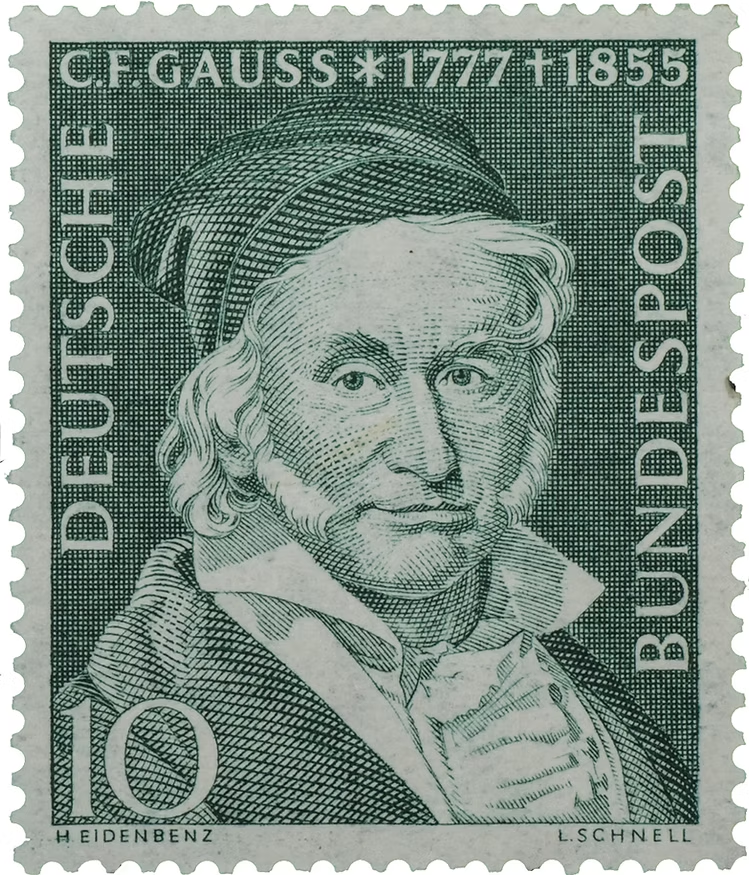
CARL FRIEDRICH GAUSS (1777–1855)
Carl Friedrich Gauss is widely regarded as one of the greatest mathematicians of all time and is often called the “Prince of Mathematicians.” He pioneered what became known as Gaussian Optics, which uses the paraxial or small-angle approximation of rays near the optical axis.

Gauss’s influence is so vast that his name appears in countless concepts: Gaussian distribution in statistics, Gaussian curvature in geometry, and Gaussian optics in physics.
Gauss’s work laid the theoretical foundation for the achromatic and aplanatic lens systems that would eventually make both the professional Magic Lantern and the early photographic camera reliable and commercially viable tools
Born in Brunswick, his contributions to physical optics were fundamental to the development of high-quality lenses used in both the camera and the projector—the two key instruments of pre cinema. His mathematical principles were the “hidden instructions” used by every major optical manufacturer to create the sharp, bright lenses necessary for the projected images of the pre cinema era.

The Fundamental Law of Dioptrics (or Dioptrische Untersuchungen) was published in 1841. Gauss formalized the theory of paraxial optics, which simplifies the analysis of a lens system by considering light rays traveling close to the optical axis (axial rays). This led to his development of the concept of cardinal points (focal points, principal points, and nodal points) for a thick lens system.
Before Gauss, lens design was often experimental (trial-and-error).
His mathematical framework allowed instrument makers to calculate and design complex, multi-element lenses with far greater precision. This was essential for the optical industry.
High-quality projection required lenses that could gather and focus maximum light without introducing significant distortion (aberration) across the image plane.
Gauss’s work laid the theoretical foundation for the achromatic and aplanatic lens systems that would eventually make both the professional Magic Lantern and the early photographic camera reliable and commercially viable tools.
Gauss’s influence is everywhere in optics.
1841
EARLY PHOTOGRAPHIC STUDIOS
RICHARD BEARD (1801-1885)
Beard opened a studio in a glasshouse on the roof of the Royal Polytechnic Institution in London on 23 March, 1841. Beard made a fortune selling Daguerreotype licenses.


CONSTABLE’S PHOTOGRAPHIC INSTITUTION
William Constable (1783-1861) had paid £1,000 to Beard for a license to take Daguerreotypes in Brighton. Constable opened his Photographic Institution on 8 November 1841.
Here is a depiction of an early Daguerreotype portrait studio, 1841.
Constable wrote to his sister Susanna and gave a progress report on his new and lucrative “I am crowded with visitors all day – from 11 to 4” enterprise;

Advertisement for William Constable’s Photographic Institution taken from the Brighton Guardian 10 November 1841.
Also, an illustration of Constable in the foreground of the early Daguerreotype portrait studio.


Having acquired exclusive British rights for the Wolcott American Pinhole Mirror Camera, Beard purchased the rights to Daguerre’s invention in England and Wales.
Beard then employed chemist John Frederick Goddard (1795–1866) to further accelerate the exposure process.
Among the techniques Goddard studied were two that Wolcott had tried:
📷 increasing the light sensitivity of the silver iodide with bromine vapours
📷 filtering the bright sunlight necessary for exposure through blue glass, to ease the portrait sitter’s eye strain


PORTRAIT SIZES
By December 1840 Goddard had succeeded in producing tiny portraits ranging from 0.4 inch to 1.5 x 2.5 inches, pictured.
By the time Richard Beard opened his studio, exposure times were said to vary between one and three minutes according to weather and time of day.
Here we see a comparison of an original, natural size Daguerreotype portrait of Goddard, versus a miniature portrait of 1.5 by 2.5 inches size (inset).


Beard’s Daguerreotype portraits became immensely popular and the studio made considerable profits the first few years, but competition soon appeared and Beard lost his fortune in several lawsuits against infringers of his licenses.
Pictured is Richard Beard late in life.
1841
ARMAND HIPPOLYTE-LOUIS FIZEAU (1819-1896)
In 1841, the physicist Fizeau replaced silver iodide with silver bromide, having greater sensitivity to light.
Time exposures of barely a few seconds were needed to obtain a Daguerreotype making it possible to produce portraits.

To further reduce the exposure time, short focal lenses were used to allow more light inside the camera. This of course created a much sharper image. Below is one of Fizeau’s favourite subjects, Saint-Sulpice in Paris, 1841.

The process not being perfect, resulted in prints often looking primitive compared to the original Daguerreotype.
These prints by Fizeau (three close ups of Saint-Sulpice below) possesses an impressive amount of detail, in the stone-and-brick walls and the small tiles in the roofs.


Fizeau etched directly into the copper Daguerreotype plate, which created a printing plate but destroyed the Dag itself.
However, the plate could then be used to make paper prints like Hotel de Ville in Paris shown here.
An etching made from a Daguerreotype plate by Fizeau in 1842.
For these and other reasons, instead of getting a proverbial stamp, the 111 km diametre lunar crater Fizeau, on the far side of the Moon, is named in his honour.
Another complimentary award like the stamp.

1841
PETER WILHELM FRIEDRICH RITTER VON VOIGTLÄNDER (1812-1878)
Voigtländer developed and manufactured the Daguerreotype Camera in 1841. This was the first metal camera (replica below). Until now all non-room cameras were made of wood.


Here is a diagram of the Voigtländer Daguerreotype Camera found in The History and Practice of the Art of Photography, Henry Snelling, 1849, figure 7, on page 48.
The all-metal Daguerreotype Camera introduced a breakthrough lens which allowed for faster exposure times for portrait Photography. An authenticated original Voigtländer Daguerreotype Camera of 1840 is housed in the Deutsches Museum in Munich.


An 1859 comic showing a photographer with a Voigtländer Daguerreotype Camera trying to elicit a pleasant expression from a subject by having him look at an unpleasant painting.


1842
SHADOW THEATRE AT THE ROXY
The Shadowplay and Shades go back a long way. As we have shown previously, Shadow Theatre and their Shadow Puppets had been practiced throughout the Orient since ancient times.
This is an illustration of a Shadow Theatre show in Algiers, from 1842.
The Shadowplay made its way to Europe later. By the 18th century it had arrived having gone through Greece, Turkey then Egypt before arriving in North Africa.
Both images are from Le Siècle du Cinema, by Vincent Pinel, published by Bordas, Paris, 1994 page 13.

1842
TELEFACSIMILE
ALEXANDER BAIN (1810-1877)
The origin of sending still photographs over a wire preceded the sending of motion pictures or video.


Alexander Bain, a Scottish inventor created pictographs in a laboratory and received a British patent Nº 9745 on 27 May. The first system of electrical facsimile transmission, Bain’s Electric Printing Telegraph recorded images on paper using Morse code signals.
It was first demonstrated in 1842 and improved on in 1843. He called his scanning device a Chemical Telegraph.
Getty Images


Getty Image
Bains’s prototype (below 1842), used a stylus on a pendulum, passing over an emulsified metal surface that sensed dark and light.
A receiving pendulum made a stain on chemically treated paper at the other end, when an electric charge signified a dark spot.
In 1850 Alexander Bain improved on his Electric Printing Telegraph from 1842-3 again, and produced this version illustrated below.
Found in the Mechanical Magazine p104, and in Dinglers Journal p40 (both) from 1850.


History tells us there was also;
🧐 1753 Scots Magazine (volume 16, p73) letter on an Electrostatic Telegraph of Francis Ronalds
🧐 1774 an Electric Telegraph by Georges-Louis Le Sage
🧐 1809 the Electrochemical Telegraph by Samuel Thomas von Sömmering, which is the one shown here

1845
BRETT’S ELECTRIC TELEGRAPH
Below is an illustration portraying components of the Electric Printing Telegraph patented in 1845 by English telegraph engineer John Watkins Brett (1805-1863).
Brett’s design consists of a piano-style keyboard linked to a type-wheel by wire.


A man named Frederick Bakewell (1800-1869) will produce his own Shellac Conducting Roller Telefacsimile in 1848, pictured.
It was a system with tin-foil covered revolving drums for transmitting and receiving recorded pictures.
the origin of sending still photographs over a wire preceded the sending of motion pictures or video
PANTÈLÈGRAPHE
The Pantèlègraphe was devised by Italian Giovanni Caselli in 1865. He created a commercial wire transmission service between Lyon and Paris. He sent nearly 5,000 transmissions in the first year.
Access was granted by Napoléon III.


PHOTOTELEGRAPH
In 1880-81, British pioneer Shelford Bidwell (1848-1909) formed a Phototelegraph. It scanned any 2D image. He transmitted Silhouettes using a selenium cell.
Pictured, his original apparatus, the earliest television-related object in the Science Museum Collection.


1877-1880
TELEPHANE
HENRY SUTTON (1856-1912)
Sutton’s Telephane was the first to break up the image of a photograph into what we today call a pixel.
The Telephane, was a long, tube-shaped appliance designed to transmit images over telegraph and telephone wires.


Australian inventor Henry Sutton’s Telephane pixelated photographs so they could be sent over telephone wires and were then re-assembled by the receiver sometimes manually as we will see.
On the discovery, Sutton wrote in his patent;

For viewers of the CBC production Murdoch Mysteries, you may recall Season 4, Episode 5 when the police c. 1900 use the Telefacsimile to solve a murder.
Interesting to see how they show the photograph being pixelated and then manually unpixelated on a 6400 square inch graph. Screenshots.


A numerically-valued grayscale is harmonized to the corresponding photograph sent, using the same 6,400 graph.
Once coloured in to match, the murderess is then identified.


The Telefacsimile is first shown at the 15:30 minute mark and can be followed at 21 minutes, 41 minutes, and 44 minutes when the murder is finally solved. The photograph wired to the police in Toronto, is sent from London, England. Screenshots.


WATCH the episode. RLJ Productions / Shaftsbury Films / CBC. See how the Telefacsimile has been used to transport a photograph via cables pre 1900. Today and for some time now, we do the same but through the air and motion pictures as well.
1842
COLOURISED ELECTROPLATING
DANIEL DAVIS JR (1813–1887)
Daniel Davis Jr. was an American photographer, Daguerreotypist, and Ambrotypist known for his contributions to early photography. In 1842, he patented a method for colouring Daguerreotypes through electroplating, a significant innovation that enhanced the visual appeal of these early photographs.

His work was further refined by Warren Thompson in 1843. Davis applied for a patent for an “Improvement in Colouring Daguerreotype-Pictures,” specification forming part of letters patent № 2826, dated 22 October, 1842.
Colourised Electroplating to be exact.
Davis’s invention was to colour the actual emulsion of the Daguerreotype through electrolysis. His claim goes on to explain how a plate is immersed in different baths of solution, each of which will produce a different colour.
Davis is quoted in his patent, explaining;


With his brother Ari, Davis set up as a Daguerrean equipment manufacturer that same year.
His 1842 Patent Nº 2286 for colouring Daguerreotypes was the third issued in photography (top half shown).
Before such an invention came along, the use of pigments in hand-colouring or hand tinting photographs would have to do.
Our five little sisters in a half-plate Daguerreotype, coloured by Davis in 1842, using his new electroplating process.
Spot the colour?


Based in Boston, Massachusetts, Davis also operated an ‘invention mill,’ a 19th-century technology think tank, and was involved in creating scientific instruments. He produced a catalogue of apparatus for demonstrating principles of magnetism, galvanism, electrodynamics, electromagnetism, magneto-electricity, and thermo-electricity, showcasing his broader contributions to science and technology.
This is a portrait of a Daguerreotypist c. 1850 shown colouring a plate with a Daguerrean colouring box along with eight bottles of powdered colours and a palette for mixing them.
Davis’s invention was to colour the actual emulsion of the Daguerreotype through electrolysis
Here is a hand-coloured Daguerreotype portrait of two unidentified firemen c. 1850.
Always wear a top hat, a big blue scarf and smoke a cigar or pipe to a fire.

My answer to the question: can you spot the colour in this 1842 Daguerreotype?
Answer:
📷 two of our little lassies are wearing a red necklace
📷 two have a gold centre-piece in their chokers
📷 one has gold ear-rings
📷 one has a gold necklace

1842-1849
EDGAR ALLAN POE
For fans of Edgar Allan Poe here are two Daguerreotype portraits of him taken by William Henry Fox Talbot. Poe was a poet and short-story writer of the macabre.
Left: The McKee Daguerreotype from 1842
Right: Poe taken several months before his death, 1849


Like Christian Huygens who had a special love for the Camera Obscura, Edgar Allan Poe revered the discovery of photography, saying it was;

1842
SIR JOHN FREDERICK WILLIAM HERSCHEL (1792-1871)
Herschel comes up with a photographic process known as the Cyanotype. It required ferrocyanate of potassium and allowed for inexpensive but permanent prints.
Below, Herschel both young and older and two Cyanotypes.


the Cyanotype is the most beloved photograph in photographic history because of its Prussian blue colour
Later in 1860, the New York Photographic Times quoted Herschel, giving us a sense of his prophetic side when he spoke on “scenes in action by photography;”

Herschel further describes in some detail how these may be made to “move on the screen.”
1843
MOVING FIGURES
T. W. NAYLOR
One of the earliest Magic Lantern animated projection instruments for the Phantasmagoria is made and used by Naylor.
His projections will decisively suggest animated sequence pictures because documentation suggests Naylor “showed moving figures.”

This image is taken directly from a letter from Naylor to the editor of The Mechanics Magazine, Museum, Register, Journal and Gazette, An Illustrated Weekly Journal for Iron and Steel, Volume 38, January to July 1843, on p319. Naylor called this his “sketch of a phantasmagoria, on a new principle capable of showing figures moving with all the appearance of life and reality.” His letter was dated 12 February. T. W. Naylor is indeed a significant figure in the history of pre cinema and animated projections.
Both the picture disk and a shutter disk revolved, allowing for the projection of what appeared to be moving figures
Naylor’s letter contained only his words and his sketch. His projections suggest “images forming,” even though there’s no description of how they could be animated in an “authentic and faithful” way. Naylor continues “In each repetition, the figures are gradually changing into another position,” intimating motion.

Naylor’s letter provided a complete legend within his sketch, as well as a full description or the workings of it. Naylor wrote to the editor of Mechanics Magazine about his Phantasmagoria for the Projection of Moving Figures, in a letter. It was published in the 7 January – 24 July issue, 1843 on pp319, 320.


Naylor’s device was illuminated by an Argand lamp. It presented sequenced pictures painted around a glass disk of a flower blooming. This is perhaps the first known application for showing sequential moving pictures twelve years after Plateau and Stampfer.

Naylor’s innovation was to integrate the sequential animation of the Phenakistiscope with the projection capabilities of the Magic Lantern used in Phantasmagoria. His device used a glass disc with sequential pictures painted on it, illuminated by an Argand lamp.
Both the picture disk and a shutter disk revolved, allowing for the projection of what appeared to be moving figures. It’s considered one of the earliest known applications for showing sequential moving pictures, appearing about 12 years after the invention of the Phenakistiscope.
Naylor further described his disks providing the motion of;
🎬 a fat gentleman feeding
🎬 a dog springing up to snatch his plum-pudding
🎬 a nest of serpents gliding off with great exactness
🎬 a lady and gentleman waltzing
🎬 Quadrille dancers
🎬 Indian juggler
🎬 a theatrical combat between two bravos
🎬 a comic figure … beating the big-drum …
🎬 a bell-ringer

So, while he might not be as widely known as some later pioneers of pre cinema, T. W. Naylor played a crucial role in the development of animated projection, combining existing technologies to push the boundaries of visual entertainment and helping to pave the way for future cinematic inventions.
READ Mechanics Magazine, Museum, Register, Journal and Gazette, An Illustrated Weekly Journal for Iron and Steel, Volume 38, January to July 1843, p319 at Google Books.
This link takes you directly to page 319.
1843
CHARLES JOHN HUFFAM DICKENS (1812-1870)
AND THE MAGIC LANTERN
Dickens has his special place in the hearts of Magic Lantern enthusiasts. He loved the optics of Victorian England so much he placed the Phantasmagoria into his novels.

Charles Dickens was fascinated by the Magic Lantern from childhood. He mentioned it in his books and used the term “Magic Lantern” as a metaphor for London, viewing the city as a source of endless, vivid imagery.
In a letter to his friend and biographer, John Forster, he famously wrote that the “toil and labour of writing, day after day, without that Magic Lantern [London], is IMMENSE!!” [emphasis Dickens].

Charles Dickens seen here at age 27, a few years before his first photographic portrait, which is now lost. From a painting by Daniel Maclise, R.A. Engraving R. Graves, 2011. His stories were also widely adapted for Magic Lantern shows during his lifetime, with professional showmen creating elaborate, illustrated slide shows for his popular works, such as A Christmas Carol. In fact, Professor Pepper even received special permission from Dickens to use his story The Haunted Man for a Magic Lantern show.
However, while his love for the device is well-documented, his primary role was as a consumer and a creative user of the Magic Lantern’s aesthetic. He was not a scholar or chronicler of its technological development or historical usage.

Dickens oft attended Magic Lantern shows and he took inspiration from these artists, who were producing make-believe ghosts by deceiving audiences.
A Magic Lantern Dickens owned, housed at the Dickens Museum.
Dickens may have seen in his mind, the answer to placing the Marley ghost and Scrooge, into the same frame of the readers mind—by using the Biunial Lantern and the Dissolving View
Dickens was a particular fan of the Dissolving View brought to us by Henry Langdon Childe in 1830.
Childe first demonstrated his Dissolving Views 31 March that year. Dickens first published work was just three years later.
There is a clear co-relation here as we will see his work incorporate these optical techniques into the fabric of his work.

The Dissolving View is familiar to us today in film as a fade in or fade out for example. What’s pervasive today however, was jaw-dropping for Dickensian audiences.
Joss Marsh, in her essay Dickensian Dissolving Views tells us regarding the creativity of the Dissolving View;

Dickens wrote the Phantasmagoria into his work, in particular his 1843 novella A Christmas Carol. First, let’s watch Scrooge, or Marley’s Ghost, known as the first film adaptation of A Christmas Carol from 1901. It was made by early British pioneer Walter R. Booth under the Robert W. Paul company Animatograph Works.
Prior to the 2011 finding of a 1900 short film titled The Death of Poor Joe, this was the earliest known example of a Dickens film adaption. This fragment is owned by BFI.
We’ll see the Dissolving View, cross-fades and super-impositions of two films overlapped to achieve the desired effect that Dickens wrote into the story. This clip is approximately 50 % of the original film and runs 3:28.
I believe Dickens may have seen in his mind, the answer to placing the Marley ghost and Scrooge, into the same frame of the readers mind—by using the biunial lantern and the Dissolving View.
This clip below is from the 1951 Renown Pictures production of A Christmas Carol. It was directed by Brian Desmond Hurst and stars Alistair Sim and Michael Hordern. This is the visit of Jacob Marley to Scrooge. It runs 7:47.
A spectacular and moving scene made that more believable by the use of optical techniques created from the pre cinema period. If Dickens could have seen this.
Dickens borrowed from Phantasmagoria artists and placed sensational spectres into his work such as the ghost of Jacob Marley—seen superimposed onto a door-knocker.
Just as he had written it.
Right, Sol Eytinge Jr.’s Marley’s Face (1868).


The superimposition of photographs onto each other in 1843 was not known of, except in the Dissolving Views of Childe – a Magic Lantern slide could seem to ‘move’ as another is replaced with a similar successive one.
Excerpt from A Christmas Carol Stave One;

Dickens was confident in his writing because the Dissolving Views of Childe back then was being seen throughout Britain and was to become a valuable and exciting part of Cinematography.
Here are two lantern slides from the time showing scenes from A Christmas Carol and a photograph of Charles Dickens working at his desk.


For Joss Marsh in her essay Dickensian Dissolving Views, Dickens “was a magic-lantern enthusiast since his childhood and was.”

Since there were no copyright rules in place at the time, Dicken’s work was freely appropriated especially if it included projected images.
Dickens himself was also greatly impacted by the enormous range of visual pre cinematic tools he observed around him in London.


Sheet-glass plates in the late 19th century could be manufactured in enormous sizes.
Dicken’s work The Haunted Man in 1862 at the Adelphi Theatre utilised these sheets, when it was presented drawing upon the Pepper’s Ghost technique.
Left, the Illustrated London News presented a scene from Dickens The Haunted Man at the Adelphi Theatre, for its readers in the 30 December issue, 1848.
Right, The Haunted Man page 34 illustration.


Invisible to the audience, the sheet of glass was placed at a 45° angle on stage, reflecting the image of a ghost-actor below the stage.
The audience saw only the reflection on stage with the ghost-actor being illuminated from below.


Dickens himself was also greatly impacted by the enormous range of visual pre cinematic tools he observed around him in London
Just like the Dissolving Views of the Magic Lantern show, we find Scrooge arising the morning after the spirits visit, and dissolving from a avaricious reclusive pessimist hermit, into a tender and empathetic humanitarian eager to give to all.
The Holy Spirit at work depicted in lantern slides of the time.


SEE Charles Dickens and the Magic Lantern explained in this BFI Dickens on Screen project beginning at the 5:15 mark of this 8:23 video. Please ignore some glaring errors and turn your sound off until 5:15.

1843
PANORAMIC CAMERAS
JOSEPH PUCHBERGER (1805-1877)
Joseph Puchberger was an Austrian photographer, chemist, and inventor from Retz, Austria. He is best known for patenting one of the first panoramic cameras in 1843, called the “Ellipsen Daguerreotype.”
This hand-cranked, swing-lens camera captured a 150° field of view on 8-inch plates, using a strip technique to create wide-angle images. His invention pioneered panoramic photography, influencing later innovations in immersive media and camera design.
The camera that you see here could make Daguerreotypes of up to 24 inches in length.
In reference to Robert Barker who coined the term Panorama in 1799, French Panorama historian Arnaud Frich who wrote Panoramic Photography from Composition and Exposure to Final Exhibition (Translated by Alan Greene, Focal Press, 2007) states on pIX of the preface;


This Ellipsen Daguerreotype kick-started a wave of innovation in cameras designed to rotate through 180 degrees while the shutter was open.
The great grandfather of the motion control camera, this camera was followed by a smooth-panning camera by Friedrich von Martens.
This a diagram of the back of the Joseph Puchberger Panoramic Camera showing the curved plates.
From his patent application in 1843.


1843
ANNA ATKINS (1799-1871)
Atkins has been said by some to be the first female photographer. She learned the Cyanotype photographic process from Sir John Herschel.
A botanist, Atkins would go on to publish British Algae: Cyanotype Impressions, self-published in 1843.

Atkins grew up surrounded by scientists. Her father John George Children was a chemist, mineralogist, and semi zoologist.
Her father and husband John Pelly Atkins were both acquaintances of William H. F. Talbot and through this relationship, Atkins would learn a wealth of information about the fledgling new art of photography.
Sir John Herschel had only discovered the Cyanotype photographic process a year earlier in 1842. He showed Anna the process as well as contact printing, which she would go on to use in her book. By 1843 Atkins was cataloging hundreds of botanical specimens using this process.


Atkins book was self-published. In June 1844, Talbot’s The Pencil of Nature was commercially published and became the first photographically illustrated book to be commercially published or otherwise known as “the first commercially published book illustrated with photographs.”
Having self-published her book, only thirteen copies are known to exist today with some of them in various stages of completion, having all been hand-written.


Later, Atkins will co-write with Anne Dixon (1799–1864), two more books with illustrated Cyanotypes: Cyanotypes of British and Foreign Ferns (1853) and Cyanotypes of British and Foreign Flowering Plants and Ferns (1854).


Referring to Atkins work, and the origin of the term blueprint that we use to this day, taken from The History of Photography – From the Camera Obscura to The Beginning of The Modern Era, Helmut & Alison Gernsheim, Thames and Hudson, London, 1969, p170.


Here is Anna Children before her marriage to John Pelly Atkins c.1820, by an unknown artist.
Possibly a self-portrait. Completed in pencil.
Resting in The New York Public Library.


1843
FIRST PHOTOGRAPHED PRESIDENT
When the first photograph was taken of a US President, he wasn’t in office. John Quincy Adams seen here in a Daguerreotype from 1843, served from 1825 to 1829.
Adams was 75 and was photographed 14 years after leaving the White House.
The Daguerreotype of US President John Quincy Adams was taken by German-born Philip Haas at Adams home in Massachusetts in 1843.
Here it is cleaned up and colourised by digital colourist Marina Amaral.


1844
ROBERT HUNT (1807-1887)
Hunt was a geologist and a keen photographer who founded the Royal Photographic Society.
He worked on a new photographic process using a ferrous sulphite paper negative known as an Energiatype that had a 14 second exposure.
Hunt also developed Fluorotype (sodium fluoride) and published its findings in Researches on Light, 1844.
Below from The History of Photography – From the Camera Obscura to The Beginning of The Modern Era, 1969 Helmut Gernsheim explains more about the Energiatype on p169.

The Hunt Energiatype with process explained by Henry Snelling from his work The History and Practice of the Art of Photography, 1849, on pp111 & 112.


The Energiatype wasn’t commercially successful.
In 1841 Hunt sent some Calotypes (3–5-minute exposures) to Henry Fox Talbot.
The Calotype technique was the first negative-positive photographic process that allowed positive prints to be made from a negative.
1844
SIR DAVID BREWSTER (1781-1868)
In 1844, Brewster invented a small hand-held viewer fitted with two biconvex lenses allowing easy viewing of images in relief. With the assistance of Moigno, he had his device manufactured in Paris by Maison Soleil-Duboscq in 1850.


1844
FRIEDRICH FROMHOLD VON MARTEN (1809–1875)
Von Martens designs and builds a Megaskop Panoramic Camera which takes Panoramic photographs 15 inches by 4 3/4, on a curved plate.
The Von Marten camera was the first to use a swing lens and curved film plate.
On the right image – hand crank (a) turned gear (b) which swivelled lens (c) slit (d) projects the image onto film (e).


Helmut & Alison Gernsheim refer to Von Martens Panorama camera, from their The History of Photography – From the Camera Obscura to The Beginning of The Modern Era, Thames & Hudson, London, 1969, on p119.

The Von Marten camera’s photos did not need to be cropped for a Panoramic result. Exposure happened through a narrow slit and a continuous image is built up as the slit is moved across the plate. Below is Panorama of Paris, (left bank of the Seine) & the Ile de la Cite, 1845.

Below, the hand-written four-page patent for Von Martens Megaskop Panoramic Camera in French. The document opens as a booklet and the top caption on p1 starts with the English translation “Descriptive memoir…”


THE PENCIL OF NATURE 1844
“The little work now presented to the Public is the first attempt to publish a series of plates or pictures wholly executed by the new art of Photogenic Drawing, without any aid whatever from the artist’s pencil.”
-H. Fox Talbot, page 25
“It may be proper to preface these specimens of a new Art by a brief account of the circumstances which preceded and led to the discovery of it.”
-H. Fox Talbot, page 30
“It may suffice, then, to say, that the plates of this work have been obtained by the mere action of Light upon sensitive paper.”
-H. Fox Talbot, p56
Here is a piece of lace that Talbot photographed in 1844. A Calotype of his own making with such clarity, focus and lucidity from 180 years ago (as of 2023). It’s 2547 x 1952 pixels. Feel free to save and open and enlarge to 100%. I think you will be amazed.

Here is what Talbot had to say on pages 55 and 56, plate XX in The Pencil of Nature;


1845-1846
BARON FRANZ VON UCHATIUS (1811 – 1881)
Uchatius next attempt at recreating motion was more technologically advanced than his first in 1834. The original version of his Lantern Wheel of Light is built using an oil lamp replacing the candle. This device contained a glass disk with an opaque shutter.


The thin-slit shutter however did not allow for a strong throw. This particular invention was created at the request of a commanding officer that wanted his troops to be trained using a teaching aid. Uchatius was a lieutenant in the Austrian forces.
Uchatius’ Lantern Wheel of Light of 1845. Using a kerosene lamp to replace his original candle, Uchatius built this with a glass disk full of 12 sequence drawings, two lenses and a crank.
When turned, the disk would revolve, as did the images thereby throwing a series of pictures on the wall and the subsequent motion with it.

These images however were cast upon the screen at approximately six inches square and were therefore too small to be effective. Uchatius would work on perfecting this device and in 1853 had an improved version.
1845
PHOTOGRAPHY MADE EASY
Fascinating reading just six years after the announcement of the Daguerreotype process. Practical Manual of Photography written by Jabez Hogg (1817-1899). E. Mackenzie, Publisher, 1845.
The first how-to book on photography? READ it here at Internet Archive.


1845
THE ROTATING DIORAMA DEVICE
PIETRO PANICALI (fl. 1845-1870)
Pietro Panicali is one of those deeply obscure, almost spectral figures in the history of pre cinema. This, because my few available sources are so scattered, speculative, and mostly uncredited in academic literature. This is therefore the first time in 35 years that I have no imagery to share.

THE ROTATING DIORAMA DEVICE
The centrepiece of Panicali’s legacy—what little of it exists—is a rotating, multi-layered Diorama that combined shadow projection, rotating glass plates, and backlit elements.

SOURCES AND SIGHTINGS
Here’s what turned up with some elbow grease.

WHY HE DISAPPEARED
My thoughts are that his work straddled the line between puppet theatre, optical science, and folk entertainment.

PHANTOM GHOST
I couldn’t find any images or visual representations of Pietro Panicali’s Rotating Diorama—no illustrations, sketches, photos, or surviving artifacts. He’s something of a phantom. However, based on the three source quotes, I must believe the device existed and was presented to many.


1845
HIPPOLYTE ARMAND LOUIS FIZEAU (1819-1896)
Fizeau’s 1st achievement in photography was to improve on the Daguerreotype process, substituting bromine for iodine.
Along with fellow photographer Léon Foucault, they collaborated for the use of celestial photography.
The first authenticated photograph taken by both Fizeau and Foucault of the sun shown here as a result of their combined efforts, 2 April 1845.
They are also known for measuring the speed of light.


Foucault was made a member of the Bureau des Longitudes and a Legion of Honour officer in 1862.
In 1864, he became a member of the Royal Society of London.
1845
JOHANN PETER MÜLLER (1801-1858)
This physicist and scientist began to use the Fantoscope and its use of disks, to study wave motion in light.
This is a genuinely interesting (and largely overlooked) case of a scientific use of a pre cinema apparatus.

Müller was the leading German physiologist of his generation, author of Handbuch der Physiologie des Menschen. By the mid-1840s he was deeply interested in optical phenomena, especially how light and motion were perceived by the retina and brain. He supervised or collaborated with several younger figures who later became prominent — Hermann von Helmholtz, Emil Du Bois-Reymond, and Ernst Brücke among them — all members of what’s now called the Berlin Physical-Mathematical Circle.

The Fantoscope Müller referred to was not a Phantasmagoria device, but a stroboscopic disk apparatus, derived from Joseph Plateau’s Phenakistiscope (1832).
By the 1840s, physicists and physiologists often renamed and repurposed Plateau’s invention a Fantaskop, but Stroboscope, and Optisches Zoisotrop were all used interchangeably.
Müller employed such rotating disks in experiments on wave interference and retinal after-images.
His goal was to explore how the visual system integrates rapid periodic stimuli — essentially, the physiology of flicker and apparent motion. Müller’s monograph On Imaginary Apparitions was published in 1826. His theory stated that the eye was a sensory system that reacts to external optical stimuli but also, can be excited by internal stimuli that we imagine.
Advertisers understand this very well.
Therefore, Müller stated that people who believe they are seeing spectres, ghosts, phantoms or other visions, might be really experiencing optical sensations and truly believe these visions to be of external origin, even if there is no external stimulus taking place. Surviving notes from Müller’s laboratory (referenced in Helmholtz’s Physiologische Optik, 1856, vol. I § 23) mention the use of “interference disks” patterned with concentric circles or radiating lines producing moiré-like waveforms when rotated against a second disk; Colour mixture disks (early Maxwell-style): to analyze optical superposition; Wave-motion simulations: where alternately patterned sectors produced the appearance of travelling light waves.


Helmholtz explicitly credits Müller’s Fantaskopische Versuche (1845) as antecedents to his own work on fusion frequency and visual persistence, which he measured quantitatively in the early 1850s.

In 1826, Müller published Zur vergleichenden Physiologie des Gesichtssinnes des Menschen und der Thiere (On the Comparative Physiology of Vision in Men and Animals).
In it, Müller described human binocular vision and the structure of the eyes.
This places him among the very earliest scientists to treat a pre cinema motion device as a quantitative physiological instrument, rather than an amusement — directly prefiguring Helmholtz’s later flicker-fusion and motion-vision studies.
Our Johann Peter Müller should not be confused with one Johann Helfrich Müller (1746-1830) who is known for his work in designing early calculating machines.
Pictured: Johann Peter Müller memorialised in the Jesuitenplatz (Jesuit Square) in the heart of Koblenz, Germany.


READ Johann Peter Müller’s On the Comparative Physiology of Vision in Men and Animals here at Internet Archive.

1845
JEAN-EUGENE ROBERT-HOUDIN (1805-1871)
French born Robert-Houdin must be mentioned in our history of Cinema if not for the marvellous work he did in designing and building his own automatons, namely his famous writing and drawing figure of the mid 19th century.
Robert-Houdin was not conscious of contributing to motion re-creation. He was a master entertainer.
However, as automatons present a realistic attempt in the illusion of real life motion, they can be remembered as significant entries in the history.


Robert-Houdin presented his first private and public performances this year which included a figure which he later sold to the American circus entertainer, Phineas T. Barnum.
Robert-Houdin created an automaton known as the Vaulting Trapeze.
In a celebrated routine, Diavolo Antonio, a sprightly child clothed in a Turkish costume and named after the famous Italian trapeze artist, was carried by the French conjurer onto the centre stage of his Paris theatre. The act of the little mechanical acrobat, driven not by clockwork but by pistons and pullcords, premiered in October 1848. It began with a bow to the audience. The trapeze was pushed by the operator, and the puppet swiftly lifted himself off the bar so he could swing from his hands as the trapeze gained momentum.
Robert-Houdin had given this automaton the name of Diavolo Antonio, a famous acrobat whose perilous exercises he had sought to imitate. He presented Diavolo Antonio for the first time in his theatre on 1 October, 1849.


Marie-Georges-Jean Méliès would purchase the 200-seat Théâtre Robert-Houdin in 1888.
Méliès had taken lessons from Emile Voisin and staged his own magic shows there as a youngster.
Here is a photo of the interior of the Théâtre Robert Houdin.

Below is the only Robert-Houdin poster known that shows his complete stage setting as it looked in his théâtre. This lithograph was made in France and is housed at the Harry Ransom Centre, University of Texas in Austin. Thanks to Dr. Eric Colleary.


From the Harry Houdini Collection
Below, is a Robert-Houdin Soirees Fantastiques (Fantastic Evenings) poster used in 1848 during a London presentation by Robert-Houdin.
Here is Robert-Houdin as he appeared to English audiences as depicted in a reproduction from the Illustrated London News, 23 December, 1848.

as automatons present a realistic attempt in the illusion of real life motion, they can be remembered as significant entries in the history
La Leçon de Chant, is an automaton by Robert-Houdin from 1844. It is found in the Gelis Collection at the Musée Paul Dupuy in Toulouse France.

SEE the Robert-Houdin automaton La Leçon de Chant (The Singing Lesson) from 1844 at the Musée Paul Dupuy uploaded by Rolla Artis @RollaArtis (at You Tube) running 1:37.
The last photograph taken of Robert-Houdin below, was used as the frontispiece for the original French edition of his Memoirs, published in 1868.


1845
CONTINUOUSLY RECORDING CAMERA
SIR FRANCIS RONALDS (1788-1873)
Starting in 1816, Ronalds built gadgets related to the field of electricity.
In 1845 he made his most notable contribution to pre cinema; a photo -electrograph camera that recorded for 24 straight hours.


This image illustrates the camera measuring and recording electrograph atmospheric electricity (temperatures). The illustration is from A History and Handbook of Photography by Gaston Tissandier, 1876, p277.
It’s of Ronalds photo-electrograph camera built in 1845.
it’s amazing how the camera has abetted so many of the sciences
Photometry is another branch of physical science which has found a powerful assistant in the operations of the photographer.
On page 275 Tissandier explains the operation of Ronalds photo-electrograph camera;


While Director of the Kew Observatory, Ronalds built the first successful movement camera to capture the continual variations of natural phenomena like air temperature and geomagnetic forces.
Ronalds’s camera aided in the science of weather forecasting at the UK Meteorological Office and was used in observatories well into the 20th century.
It’s amazing how the camera has abetted so many of the sciences.
Thomas Malone photo of Francis Ronalds, c.1850 The Royal Society.

Sir Francis’ most noticed invention, his electric telegraph, was demonstrated nearly two centuries ago in 1845. In creating it, he was not only envisaging a future electrical age, but even a world of “electrical conversations” somewhat similar to what we enjoy today.

1846
PROFESSOR JOHANN PETER MÜLLER (1801-1858)
Müller uses the Stampfer Stroboscope of 1832, to demonstrate numerous sorts of work including the basic laws of wave theory. Much of Müller’s contribution to pre cinema has been overlooked but I have spoken on him before and his use of the Fantoscope for the same purpose. His theory stated that the eye was a sensory system that reacts to external optical stimuli but also, can be excited by internal stimuli that he believed we ‘imagine.’ Advertisers understand this fact very well today as do we, without even thinking, when we shop.

Now, with respect to video games and, more specifically, those incorporating AI, Müller’s studies on the stroboscopic concept of the Phenakistiscope and Stroboscope have been far more widely shared.
I have found documentation that was initiated by Liesegang and exaggerated by Johann Christian Poggendorff’s Annalen der Physik und Chemie (1824), that Müller created eight figures that he used in the wheel of life to illustrate the basic laws of wave theory. They were lithographed by printer J. V. Albert in Frankfurt and “brought into the market” to demonstrate the wave motion he wanted to exude.
As well, Quincke later printed comparable wave images for a revolving drum. This almost sounds like an Optokinetic Drum. Here are examples of two drums for diagnosing vision irregularities. Left animation by Harold Marcuse. Right animation by Vestibular Rehab Made Easy.


Finding these eight figures or anything about them other than these two mentions, has been like pulling teeth.
Pictured is the front cover of Müller’s On the Comparative Physiology of Vision in Men and Animals.
READ it here at Internet Archive.


1846
An authenticated Daguerreotype of Abraham Lincoln taken shortly after he was elected to the U.S. Congress.
Verification is by the Library of Congress and it sits in their collection.
He was 37 years-old.
The Congressman-elect was a frontier lawyer in Springfield, Illinois.
This photograph of President Lincoln only 18 years later in 1864, shows the ravages of national worry and concern, over the civil war as if painted across his face.
Lincoln was assassinated on 14 April 1865, just a year later.


1847
LEOPOLD LUDWIG DÖBLER (1801-1864)
Ludwig Döbler was a well-known and efficacious European showman in the early nineteenth century.
He drew large crowds to his moving picture shows when they commenced in early 1847.
In January 1847 Ludwig Döbler began giving shows of living pictures by means of a projecting lantern that he had just patented called a Phantaskop.
His appearances began at the Josephstadt Theatre in Vienna. A large theatre poster highlighted here, from his pre living pictures period.

Döbler’s Phantaskop had 12 lenses each projecting its own sequenced images providing a depiction of modest motion. Two core lenses rotated by a crank directed limelight illumination at each of the 12 lenses successively.
Austria honoured Döbler with the proverbial postage stamp.


With no mention of Döbler using a strip or band for his pictures, I’m wondering if the postage stamp gives a clue as to how the Phantaskop worked.
Is it possible that he used a disk of some sort to hold the pictures?
I’m wondering what the object is, over his left shoulder.
Ludwig Döbler began giving shows of living pictures by means of a projecting lantern that he had just patented called a Phantaskop
On 16 January, 1847, Ludwig Döbler delivered his first public showing of stroboscopic moving pictures at the Josephstadt Theatre in Vienna. Dissolving Views and Chromatropes were a large part of his performance.
Below is Döblergasse (street) in Vienna named after Döbler.


Döbler projected eight movement sequences using Franz Geyling’s sequenced paintings including; The Turkish Conjuror: The Ring Jumper: Small Parade: The Woodcutter: The Chinese Conjuror: The Strutting Dancer: The Tightrope Walker: and The Valiant Rescuer pictured here.
Leopold Ludwig Döbler was a renowned and successful European showman who, once he entered what he called his “moving” or “living picture” show period, was in it for just three years.
Here is a known list of his presentations from historian Deac Rossell.

Left- the painting called The Opening of The Theatre in der Josefstadt in Vienna by Robert Schumann in 1822, for which Beethoven wrote the overture for the consecration of the house.
Döbler performed here many times in early 1847. Right- how der Josephstadt looks today.


on 16 January 1847, Ludwig Döbler delivered his first public showing of stroboscopic moving pictures at the Josephstadt Theatre in Vienna
Döbler was an eminent showman and conjurer before and during his moving pictures period (1847-1849). He entertained royalty across Europe.
He had streets named after him and like today, a clothing line styled and marketed after him. In 1850 he sold all possessions, and retired.

1847
EARLY PHOTOGRAPHY
A Daguerreotype of American poet Emily Dickinson age 17 below. This is the only known authenticated photograph of Emily.

The Daguerreotypist who took this portrait of miss Dickinson is unknown. It was taken in 1847.

1847
CLAUDE FELIX ABEL NIEPCE DE SAINT-VICTOR (1805-1870)
St. Victor announces the making of Albumen negatives on glass. The Albumen process used extract from the white of eggs added with other light-sensitive agents.
In 1850, Albumen prints will be made by Blanquart-Evrard.
Niépce de Saint-Victor experimented with negatives made with Albumen on glass and worked on the fixation of natural photographic colour.
In 1851, he showed that a silver plate coated with a layer of pure silver chloride reproduced colours directly, but in an unstable manner.

Here from The History of Photography – From the Camera Obscura to The Beginning of The Modern Era, Helmut and Alison Gernsheim, Thames and Hudson, London, 1969, p63.

Left- Here is a portrait of Claude Félix Abel Niépce de Saint-Victor from 1852. An experimental Collodion positive on glass, measuring 235 x 178 mm.
Right- 1860 portrait by Nadar of Niépce de Saint-Victor hanging at the Bibliothèque Nationale de France.


Honoré-Victorin Daumier (1808-1879) The most practical position to achieve a nice portrait with a Daguérreotype, in 1847, seeing as you had to sit for so long you might as well be comfortable.
Honoré Daumier’s clever cartoons made him one of the most well-known social and political observers of his time, and put him in jail once, for insulting the reigning monarch.
With the exception of the working class and the impoverished, Daumier pioneered a Realism style that concentrated on people from all social classes and spared few from his biting humour and scrutinising eye.
COLOUR PHOTOGRAPHS IN 1848
ALEXANDRE-EDMOND BECQUEREL (1820-1891)
Becquerel observed in 1840 that silver halides, previously thought to be immune to red & yellow light, grew sensitive to that part of the spectrum as their exposure to blue, violet, and ultraviolet light increased.
This method was seldom used.
However, Becquerel did use a technique since discovered to have been analogous to the Lippmann wave interference process.

This is documented to have generated colour photos of images obtained in the Camera Obscura in 1848, but no proof of this is known to exist. No photographs have ever been found. Becquerel was a French physicist renowned for his pioneering work in photovoltaics, luminescence, and electrochemistry. He is best known for discovering the photovoltaic effect, the principle behind solar cells, and for his extensive studies of light-related phenomena, including fluorescence and phosphorescence.

THOMAS JOHANN SEEBECK (1770-1831)
Seebeck was a Baltic German physicist best known for discovering the thermoelectric effect, also called the Seebeck effect, which describes the generation of an electric voltage in a circuit made of two different metals when their junctions are at different temperatures. Earlier in 1810, Seebeck may have been the first to record the solar spectrum in natural colours using silver chloride (AgCl), contributing to the imminent birth of photography and the future for Cinematography.


new optical applications will allow movie characters to step off the screen, and sit down beside us
Let’s remember that Buster did it first in Sherlock Jr. (1924).
Well before the beginning of colour photography, Seebeck, Niepce de Saint-Victor, Becquerel and Poitevin have all been recognized as pioneers of the interference colour photography method.
This led to Holography which would be incorporated in the Cinematography of our time.

Holography is just as popular with filmmakers as it is with moviegoers. Holograms are an engrossing piece of modern optical technology that captures both our attention and our imagination.

Holograms are an optical technology of today’s Cinematography. Cameras sweep through the Holographic light, and on-screen characters manipulating that light which as we’ve shown. Technology that was born 214 years ago.

Not only fun to watch on screen, Holography is advancing with companies like Industrial Light and Magic, at light speed. New optical applications will allow movie characters to interact with us.

1848
EDWARD MARMADUKE CLARKE (1806-1859)
Clarke published a book in London on the use of the oxy-hydrogen blowpipe which was invented by Robert Hare in 1802.

He wrote about its use in educational presentations using a Magic Lantern.
Clarke’s work was Directions for Using the Philosophical Apparatus in Private Research and Public Exhibitions. Here, Clarke’s oxy-hydrogen blowpipe illustration on p9. It can also be seen in Clarke’s Catalogue of Optical Instruments, 1840, figure 16, p49.


Pictured here is Clarke’s projection of the formation of magnetic curves of minute particles of iron filings on the poles of a horseshoe magnet using a Projection Lantern powered by Hare’s blowlamp.
From Clarke’s Catalogue, and Company of Optical Instruments, 1840, figure 3 on p7.


From Directions for Using the Philosophical Apparatus in Private Research and Public Exhibitions written by Edward Marmaduke Clarke on page 10 figure 9, we see the Lantern housing used for projection.
READ Directions for Using the Philosophical Apparatus in Private Research and Public Exhibitions written by Edward Marmaduke Clarke at Google Books (this version has the illustration on p10).


1848
THE GIRONA FANTASCOPE
Another amazing exhumation of our pre cinema past happened in 2014 at a former high school in Girona Spain.


Like the Moisse Fantascope, this Phantasmagoria Fantascope Magic Lantern is also in near pristine condition. Girona Museum.
From the school’s construction in 1841 until its change-over into the Girona History Museum in 1968, this three-chimney Fantascope of the glorious Phantasmagoria age, began it’s hibernation undisturbed and undiscovered for 46 years (1968-2014).

Manufactured by Lerebours et Secretan of Paris in the mid-1840s, it resides at the Museu del Cinema. The Girona Fantascope was discovered in the storerooms of the Museum (the former high school), where it was identified by the Museum Director, Jordi Pons.


Archival research by professor Daniel Fernández, University of Girona revealled this Fantascope was bought by the school in 1848. Like the Moisse Fantascope, other accessories accompanied the Girona Fantascope, like five astronomical Chromotrope glass slides, with four of them pictured here.


In a June 1849 inventory, the lantern is mentioned among the assets of the school’s physics department. According to the list, three sizable acquisitions of scientific optical instruments were also made between 1846 and 1849. All were from Paris-based manufacturers.
I have already spoken about some of these devices in previous chapters, or will speak about the remainder in following chapters.
It is amazing to see that high school students in 1848 were being taught about these optical instruments as contemporary to their time, and not as historical as we view them today.

The children in this class were certainly getting an education in pre cinema.
In the 1846 Lerebours et Secretan catalogue there was a very interesting memorandum found, mentioning a gentleman I have talked about before.
It stated;

The description in the Lerebours et Secretan catalogue and the Girona Fantascope closely match, as we see below on page 16 (the 1850 catalogue).


Again, on page 16 of the Lerebours et Secretan catalogue we see listed the Tableaux astronomique Chromotropes that were found with the Girona Fantascope in the storeroom of the then high school in 2014.

A separate, wider aperture lens is often used when operating a Megascope, allowing more light to pass through but has less accurate focusing. Alfred Molteni explains this in Practical Instructions on the Use of Projection Devices pp199-206;

from the school’s construction in 1841 this three-chimney Fantascope of the glorious Phantasmagoria age, began it’s hibernation undisturbed and undiscovered for 46 years
All images and information are reproduced courtesy of Daniel Fernández. Some background information is extracted from History of a Fantascope: A Device for Education in Nineteenth-Century Girona.
As Professor Fernández states on page five of his article on the discovery;


READ the Daniel Fernández article History of a Fantascope: A Device for Education in Nineteenth-Century Girona, Early Popular Visual Culture, Volume 15, issue 1, February 2017, PDF format (downloads automatically here).
The Girona Fantascope is on display at Museu del Cinema – Collecció Tomàs Mallol.


1848
CHARLES H. FONTAYNE (1814-1901)
WILLIAM SOUTHGATE PORTER (1822-1889)
Fontayne and Porter took a Panorama of the Cincinnati waterfront consisting of eight-plate Daguerreotypes. The camera was on a roof, on the Kentucky side of the Ohio River. Plate № four below.

Titled Daguerreotype View of Cincinnati Taken from Newport, Kentucky today known as The Cincinnati Panorama. It resides at the Public Library of Cincinnati, Ohio. SEE these eight plates sewn together for a full (3600 x 293 pixels) Panoramic view at my first edition website first published online in October 1999 here my first edition website.
Thanks To John Reusing for his assistance


VIEW This Cincinnati Waterfront Panorama Daguerreotype at Codex 99 here at http://www.codex99.com/photography/5.html.
SEE all eight large-format (9197 x 750 pixels) digitised Daguerreotypes and read the full story.
View this full-size interactive Panorama of The Cincinnati Panorama here at Panorama of Progress Building: a City in the Photographic Age at https://1848.cincinnatilibrary.org/ and zoom in/out and identify the buildings in the photo.

1848
JOSEPH ANTOINE FERDINAND PLATEAU (1801-1883)
Plateau states he wished he could place photographs on disks in the use of motion study analysis, in place of the still-used, drawings. Enter the Langenheim brothers. Less than two years later they gave us the Hyalotype;

1849
SIR DAVID BREWSTER (1781-1868)
Brewster designs a Stereoscope with binocular lenses for photographing Stereoviews. Until now all Stereoscopic Photographs were taken using two successive exposures using a single lens. Illustration of the Brewster Stereoscope.


Brewster’s Refracting Lenticular Stereoscope did not use mirrors.
It used convex lenses. Wheatstone’s discovery of Stereography was now improved upon.
A manufactured Brewster Stereoscope shown here.

Pictured is a foldable Stereoscope by David Brewster, in an illustration from 1877 on the left, and on the right is a very simplistic illustration how the eyes and lenses worked inside the device.


Here we have two Brewster Stereoscopes; with an open back and a closed back.


The opening page illustration of Brewster’s A Treatise on Optics, Natural Philosophy & Optics, (published by Longman, Rees, Orme, Brown and Green, London, 1831) showing five children experiencing different optical wonders—a Kaleidoscope; Telescope; a Magic Lantern and a Mirror.


READ Sir David Brewster’s A Treatise on Optics, Natural Philosophy & Optics at Internet Archive.
Images Pierre Patau and Elisabeth Calley
1849
LORGNETTE PITTORESQUE POCKET POLYORAMA PANOPTIQUE
PIERRE HENRI AMAND LEFORT (1804-1880)
The pocket Polyorama Panoptique was called the Lorgnette Pittoresque viewer and is a combination of the 19th century Peep Show viewer and Daguerrean Diorama.

Lefort’s Lorgnette Pittoresque is extremely rare and I thank Pierre Patau and Elisabeth Calley for these images.
This pocket-sized Polyorama Panoptique called the Lorgnette Pittoresque was patented in 1849.

When the top flap with reflecting gold paper is open, the light is thrown onto the view.
When the top flap is closed and the front panel is open, the light shines through the view and a magical transformation is revealed.


Here is the Polyorama Panoptique on the left which I have talked about in previous posts, and the pocket-sized Lorgnette Pittoresque on the right which is 6.7 inches long.


Images Pierre Patau and Elisabeth Calley
The Lorgnette Pittoresque is extremely rare, pocket-sized with transformation views – three shown here.
The views are 3.9 inches in diametre.
The first time I saw a Lorgnette Pittoresque I wondered if NASA had based their designs of the Mercury / Gemini space program capsules [1961-1966] on this 19th century Peep Show viewer. Just wondering.


| Welcome | About | Introduction | Chapter One beginning of time – 999 AD |
| Chapter Two 1000 AD – 1399 | Chapter Three 1400 – 1599 | Chapter Four 1600 – 1649 | Chapter Five 1650 – 1699 |
| Chapter Six 1700 – 1749 | Chapter Seven 1750 – 1799 | Chapter Eight 1800 – 1819 | Chapter Nine 1820 – 1829 |
| Chapter Ten 1830 – 1839 | Chapter Eleven 1840 – 1849 | Chapter Twelve 1850 – 1859 | Chapter Thirteen 1860 – 1869 |
| Chapter Fourteen 1870 – 1879 | Chapter Fifteen 1880 – 1884 | Chapter Sixteen 1885 – 1889 | Chapter Seventeen 1890 – 1894 |
| Chapter Eighteen 1895 – 1899 | Chapter Nineteen 1900 + post cinema | Chapter Twenty 1911 + | Copyright |
| HOTDOC Internet Archive Channel | HOTDOC X Channel | HOTDOC You Tube Channel |
| Powered by planetelcommunications |
